
Have you ever thought about whether Earth's shape might be hiding secrets? Our planet isn’t a perfect ball. In fact, its diameter changes depending on where you measure. At the equator, Earth stretches out a bit more than the distance from one pole to the other.
Scientists have gathered clear, reliable data that compares these different measurements. They explain what the numbers mean and why even tiny differences are important, not just for science but for our everyday lives. For example, slight changes in measurements can affect gravity and play a big role when launching space equipment.
Isn’t it fascinating how even small details about our planet can have such big effects?
Earth’s Diameter: Equatorial, Polar, and Mean Measurements
When we look at our planet, it's clear that Earth isn't a perfect sphere. The distance measured across its middle, the equator, is about 12,756 kilometers (roughly 7,926 miles). In contrast, if you go from one pole to the other, the span shortens a bit to around 12,725 kilometers (approximately 7,907 miles). This happens because the planet is a bit squished at the poles and bulges out a little around the equator.
If we combine these two measurements into an average, Earth comes out to about 12,742 kilometers (or around 7,917.5 miles). And here's another fun fact: if you walked all along the equator, you'd travel nearly 40,075 kilometers (about 24,901 miles)! This averaging smooths out the tiny differences in Earth’s shape, giving us a neat overall number.
That small gap of about 31 kilometers (or 19 miles) between the equatorial and polar diameters may seem minor, but it’s pretty important. Earth’s rotation causes this tiny difference, and it even affects things like gravity and decisions on where to place space launch sites. Have you ever wondered how such small numbers can have a big impact? It's one of the many cool quirks of our planet!
Oblate Spheroid Shape and Diameter Variations
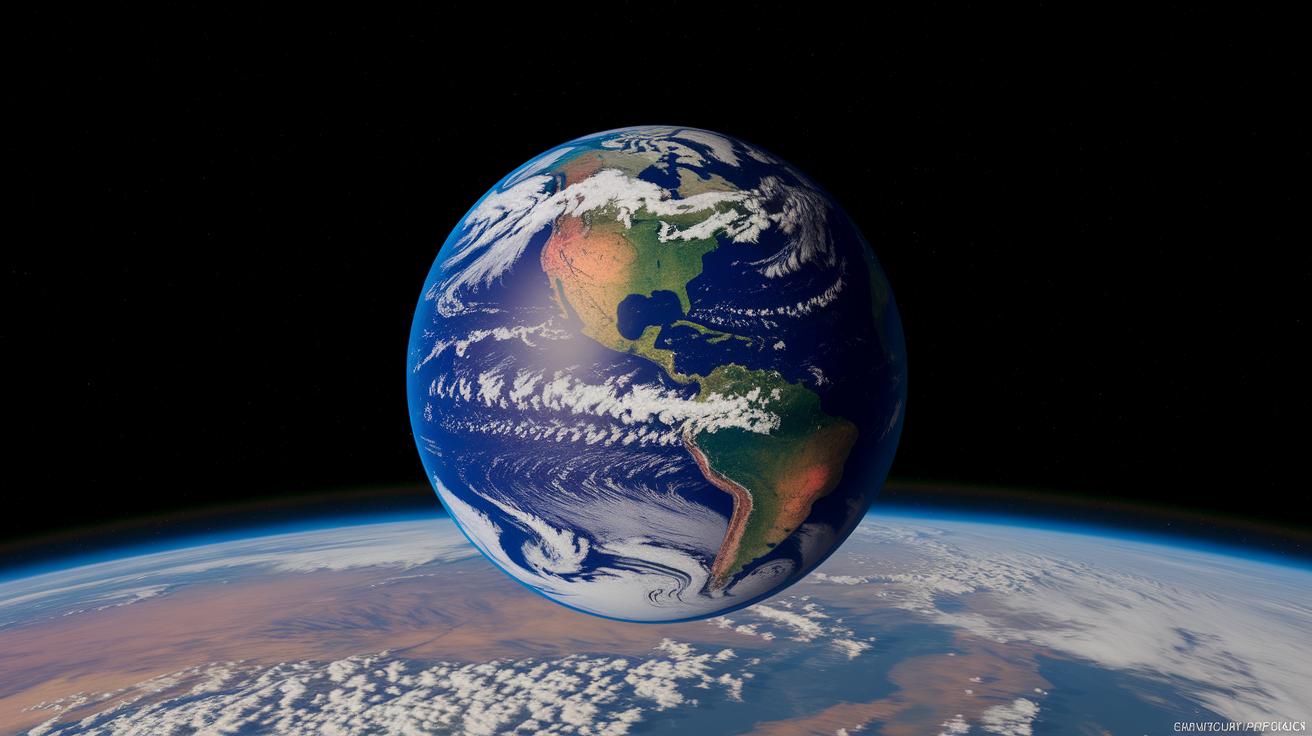
Earth is shaped like an oblate spheroid. This means the planet is a bit squished at the poles and bulges out along the equator because it spins. Imagine a spinning water balloon that gets a little fuller in the middle – that’s the idea.
When you measure from Earth’s center, the distance to the surface at the equator is about 6,378 kilometers (roughly 3,963 miles). At the poles, it’s around 6,356 kilometers (about 3,950 miles). So, the diameter across the equator ends up being nearly 43 kilometers (27 miles) larger than the pole-to-pole measurement. Picture two circles where one looks a little wider in the middle because of its spin.
This bulge changes how gravity works on our planet. Gravity is a bit weaker at the equator compared to the poles. It’s like a spinning top where the outer edge feels a little different from the center. Even these small differences in gravity are important, especially when scientists make precise measurements or plan space missions. Earth’s shape and its gravitational pull are closely linked.
How Scientists Measure Earth’s Diameter
Measuring Earth’s diameter accurately is important because it helps us understand everything from global navigation to the planning of space missions. When scientists know Earth’s exact size, they can create better maps and build more efficient satellite systems. Early methods set the stage for modern precision, and each improvement gives us a clearer view of our home in the vast universe.
Eratosthenes and Ancient Measurements
More than two thousand years ago, Eratosthenes used the angle of shadows and basic trigonometry (a simple way to study triangles) to estimate Earth’s circumference with about one percent error. His method was based on earlier ideas, like Aristotle’s estimate of roughly 73,225 kilometers (about 45,500 miles). By comparing the length of shadows in different places, he turned everyday observations into powerful numbers. It’s amazing how such simple techniques paved the way for modern science.
Modern Geodesy Techniques
In the 17th and 18th centuries, scientists took measurements to a new level by using triangulation and careful astronomical observations. Today, the field of geodesy uses modern tools like satellite ranging, GPS, and very-long-baseline interferometry (a method that uses distant signals to measure distances) to measure our planet with precision down to the centimeter. These advanced techniques even account for tiny shifts in Earth’s shape, giving us a level of clarity that ancient methods could only dream of.
Even now, researchers keep refining these methods, consistently pushing the boundaries of how accurately we can measure our planet’s size. It truly shows how far our understanding has come, from simple shadow observations to highly precise modern technology.
Unit Conversion Guide: Kilometers and Miles for Earth’s Diameter
Ever wonder how we switch between kilometers and miles? It all comes down to a couple of simple factors. One kilometer is about 0.621371 miles, and one mile is roughly equal to 1.60934 kilometers. Back in the day, before modern instruments, scientists used basic ratios like these to estimate distances, a practice that still underpins many of our measurements today, whether in astronomy or everyday travel.
Think of these conversion numbers as a handy toolkit. To change one unit into the other, just multiply the amount by the right factor. For example, if you have 10 km, multiplying by 0.621371 gives you about 6.21371 miles. Researchers continue to rely on methods refined from centuries of measuring Earth, ensuring their calculations stay precise and reliable.
| Context | Kilometers | Miles |
|---|---|---|
| Basic Conversion | 1 km = 0.621371 miles | 1 mile = 1.60934 km |
| Astronomical Calculation | Large distances measured in km | Convert using 0.621371 for scale |
| Practical Usage | Everyday travel distances in km | Mileage for road trips |
| Historical Standardization | Based on centuries-old Earth measurements | Evolved into modern imperial units |
Impact of Earth's Diameter and Shape on Gravity and Space Operations
Earth isn’t a perfect round ball. Because it spins, its poles get a bit squashed while the middle stretches out. This means gravity feels a bit lighter at the equator than at the poles. Imagine a spinning top, someone near the edge feels a gentler pull. That small difference helps us understand how Earth's forces work.
Our planet is enormous. It holds about 1.086 trillion cubic kilometers of space, weighs nearly 6 x 10^21 metric tons, and has an average density of about 5.5 grams per cubic centimeter. Fun fact: Before Marie Curie became world-famous, she carried small tubes of radioactive material in her pockets, not knowing the risks that would later shape her legacy.
This unique shape also plays a big role in space travel. Launch sites near the equator get a natural boost from Earth's wider part, making it a bit easier for rockets to overcome gravity. This clear link between Earth’s measurements and space missions shows why some locations are better for launching satellites and spacecraft.
Final Words
In the action, we reviewed Earth’s size using clear equatorial and polar comparisons in both kilometers and miles. We touched on how scientists measured these numbers from ancient times to modern satellite technology. We also explored conversion tips to help you see the connections between different units and why Earth’s slight bulge matters so much in space operations. Stay curious and keep asking questions about our planet’s unique design, what is earth diameter.
FAQ
What is the Earth’s diameter in miles, kilometers, and meters?
The Earth’s diameter means its equatorial span is about 7,926 miles (12,756 km) or roughly 12,756,000 meters, while the mean diameter is slightly lower at approximately 7,917.5 miles (12,742 km).
What is the length of the Earth?
The length of Earth refers to its equatorial circumference, which is about 24,901 miles (40,075 km), describing the distance around the planet along its widest point.
What are some key facts about Earth?
Key facts about Earth include its oblate spheroid shape with a slight polar flattening, abundant water coverage, and diverse life-supporting ecosystems that make it unique among known planets.
What is the diameter of the Moon?
The diameter of the Moon is its size across, measuring around 2,159 miles (3,474 km), which is much smaller than the Earth’s diameter but significant for our closest celestial neighbor.
What is the lifespan of the Sun?
The lifespan of the Sun indicates a total life expectancy of roughly 10 billion years, with its current age around 4.6 billion years, meaning it has several billion years left to shine.
What is the coldest planet in our solar system?
The coldest planet means the one with the lowest average temperature, and Uranus holds that title with temperatures dropping near -224 °C, making it extremely frigid.
Could life exist elsewhere in the solar system?
The possibility of life elsewhere in the solar system arises from environments like subsurface oceans on moons, where conditions might allow microorganisms or different life forms to survive despite harsh surroundings.
How does Earth’s size compare to Mars, Jupiter, Venus, Saturn, and Mercury?
Earth’s size means it is larger than Mars and Mercury, smaller than Jupiter and Saturn, and quite similar to Venus, making it uniquely balanced for retaining an atmosphere and supporting life.