
Five neuroscience advances this week could shift how we diagnose and treat brain disorders. An AI called DunedinPACNI can read a single MRI and stratify dementia risk decades before symptoms appear. New single-cell RNA work finds neural progenitors persist in people into their late 70s, raising hope for repair. Two clinical trials sharpen acute stroke care: one adds the antiplatelet tirofiban after standard clot-busting to reduce reocclusion and improve outcomes, and a JAMA study shows delivering tenecteplase through the thrombectomy catheter boosts neurological recovery without extra bleeding. Basic science implicates neuron-derived IL-34 in microglial pruning and behavior. These findings are promising but need wider validation.
Five neuroscience breakthroughs this week that could change brain treatment

Five neuroscience advances this week could shift how we diagnose and treat brain disorders. An AI called DunedinPACNI can read a single MRI and stratify dementia risk decades before symptoms appear. New single-cell RNA work finds neural progenitors persist in people into their late 70s, raising hope for repair. Two clinical trials sharpen acute stroke care: one adds the antiplatelet tirofiban after standard clot-busting to reduce reocclusion and improve outcomes, and a JAMA study shows delivering tenecteplase through the thrombectomy catheter boosts neurological recovery without extra bleeding. Basic science implicates neuron-derived IL-34 in microglial pruning and behavior. These findings are promising but need wider validation.
One MRI scan predicts dementia decades early

New AI MRI predictor (DunedinPACNI) reads a single brain MRI to produce a risk metric that predicted dementia decades before clinical onset. The team reports each 1-point increase in the score associates with a 60% higher dementia risk, 18% higher chance of chronic disease, and a 40% higher death risk for 'fast agers' – people whose brains look older than their years. Clinically this could enable earlier lifestyle or trial interventions and better risk stratification. But adoption needs external validation, transparent thresholds, and careful handling to avoid overdiagnosis and anxiety from early risk labels. Researchers also need to test performance across populations to avoid bias.
Your brain keeps making neurons even at 78

Single-cell RNA sequencing of over 100,000 cells found neural progenitor cells in human hippocampi from newborns up to age 78, overturning the long-held idea that adult neurogenesis ceases in early life. The study showed substantial heterogeneity: some older individuals retained many progenitors and signatures of new neuron formation, while others had few. New neurons in the hippocampus are linked to memory and mood regulation, so persistent neurogenesis could explain why some people maintain cognitive resilience with age. Future work will explore what drives this variability – genetics, lifestyle, or disease exposure – and whether we can therapeutically boost neurogenesis. If reproducible, it opens doors for regenerative therapies.
Stroke treatment breakthrough: tirofiban after clot-busting

A NEJM randomized study tested adding the short-acting glycoprotein IIb/IIIa inhibitor tirofiban after standard intravenous clot-busting therapy in acute ischemic stroke. Results showed 65.9% of patients reached excellent recovery versus 53% with standard care, and early re-occlusion rates fell by roughly half. The trade-off was a modest rise in symptomatic intracranial bleeding (3% vs 0.8%). Benefits were time-dependent – giving tirofiban within about 60 minutes of thrombolysis mattered. These data suggest targeted antiplatelet therapy can stabilize reperfusion and improve outcomes, but clinicians must weigh the incremental bleeding risk and confirm findings in broader populations before changing guidelines.
Autism's immune connection: neuron-derived IL-34 and microglia

Basic science work shows neurons communicate with microglia via the cytokine IL-34 to regulate synaptic pruning, a critical process in circuit refinement. Experimental blockade of IL-34 in mice impaired normal microglial pruning and produced behaviors resembling autism spectrum disorder, with stronger effects in males. This is the first clear evidence of a direct neuron->immune->behavior pathway, pointing to immune signals as active contributors to neurodevelopment. The finding reframes some neurodevelopmental questions and suggests immune-modulating strategies could be explored, but translating mouse behavior to human autism requires extreme caution and deep mechanistic follow-up. Human studies will need to assess IL-34 levels, genetics, and microglial function in neurodevelopmental cohorts.
Tenecteplase through the same catheter after clot removal boosts recovery
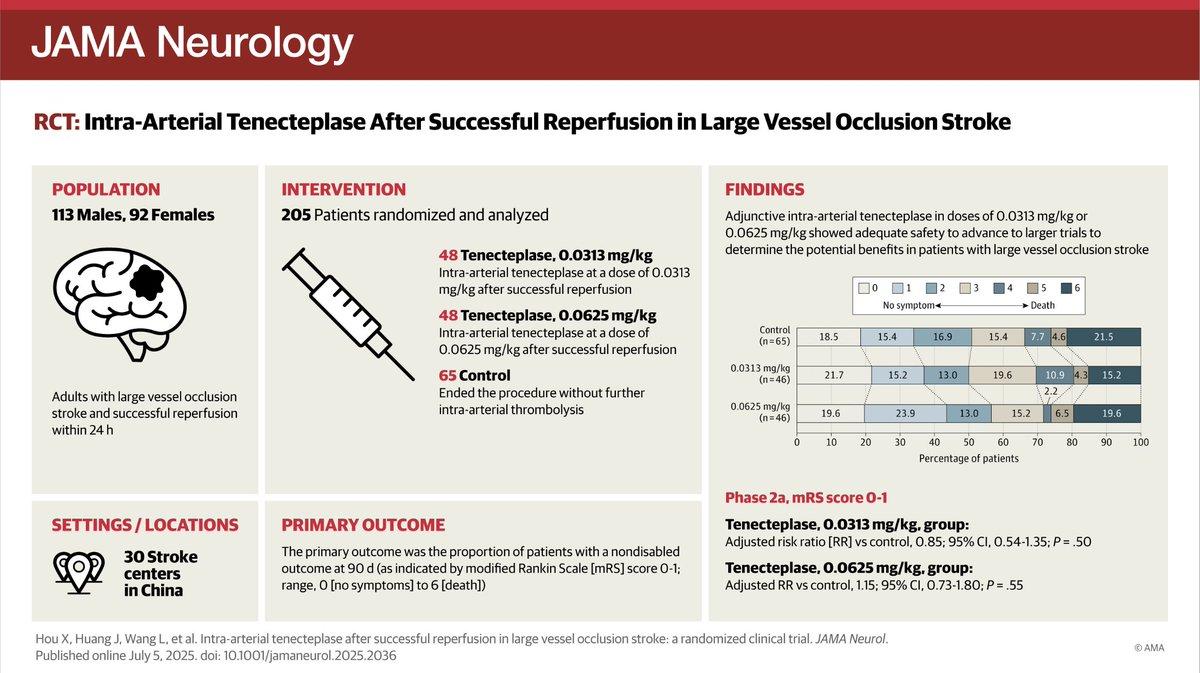
A JAMA trial evaluated delivering tenecteplase directly through the same microcatheter used for mechanical thrombectomy after clot removal. Localized delivery deposits the thrombolytic right at the damaged bed and was associated with larger neurological improvements without an increase in bleeding complications. Because it uses the existing procedural setup, adoption could be rapid if results replicate. This approach may complement mechanical reperfusion by dissolving residual microthrombi and stabilizing microcirculation. As with all procedural tweaks, operators will need protocolized dosing and safety monitoring, and larger trials should confirm which patients benefit most. Regulators and societies will want consistent evidence across centers before updating practice guidelines.

