
Have you ever thought about a smart suit that might help stroke survivors stand taller and walk again? Imagine a wearable exoskeleton that wraps around your body like a supportive brace.
This suit uses sensors (small devices that detect movement) and clever software that adapts in real time. It steps in just when you need a boost in strength and confidence during rehabilitation. In truth, these innovative devices are changing the game for stroke recovery, offering hope and a fresh start as people work hard to regain their independence.
Breakthrough Innovations in Wearable Exoskeletons for Stroke Rehabilitation
These new wearable exoskeletons help stroke survivors stand and walk by fitting snugly around the legs, hips, and waist. They run on batteries and work like supportive braces that encourage the brain to reconnect with the legs. Have you ever thought about how amazing it is to relearn to walk with a little tech by your side?
At Georgia Tech, for example, engineers have created an AI-powered exoskeleton that adjusts with every step you take. It’s like having a smart helper that fine-tunes your movements without you having to worry about manual adjustments. It really makes you feel more confident with every stride.
These devices don’t just assist movement, they also work to keep muscles strong during rehabilitation. Many companies now blend robotics with exoskeleton design to boost physical therapy. Instead of the old models that needed constant tweaking, the new ones come with cool sensors and adaptive control systems (this means devices that can change based on how you move). This smart technology takes the strain off both the patients and the therapists.
One of the biggest breakthroughs is a special adapter software that synchronizes data across various exoskeleton systems. This software cuts down mistakes by more than 75% after just ten steps, making the support both precise and real-time. This tech upgrade builds confidence and makes rehabilitation smoother and more effective. By combining advanced exoskeleton technology with innovative wearable designs, these devices are now a vital tool for stroke survivors on their journey to recovery.
Design and Technology Behind Advanced Stroke Rehabilitation Exosuits

Georgia Tech’s AI exosuit mixes smart hardware and software that adjusts on the fly to how a stroke survivor moves. The suit uses a sensor array (tiny detectors that notice movement) to keep track of each step and runs adaptive control algorithms (clever formulas that tweak its actions based on your walk) to help you move smoothly. Instead of having to fiddle with manual knobs like older models, this suit automatically fine-tunes its signals so your movement feels natural. One user even said it felt like the suit "understood my every step without needing constant tweaking."
At its core, the exosuit is designed to handle the everyday changes in a patient’s way of walking. It’s built specifically for stroke survivors, so it considers the unpredictable step patterns that differ from those of healthy adults. The system also uses a universal adapter integration, which means it gathers sensor data from different devices and makes them speak the same language. This breakthrough cuts out the need for manual adjustments while smoothly managing many sensor inputs.
Key components of this innovative system include:
- Sensor array and calibration module
- Adaptive control algorithms
- High-torque actuators and motors
- Universal adapter integration
This inventive setup transforms exosuits into active rehabilitation tools that constantly adjust to each patient’s unique movements, boosting recovery and confidence with every step.
Clinical Efficacy and Research Evidence for Stroke Rehabilitation Exoskeletons
Recent studies show that wearable exoskeletons can really help stroke survivors move more easily. US News & World Report (Jan 2020) pointed out that robot-assisted walking therapy plays a big role in many recovery programs. These devices support movement, help prevent muscles from weakening, and even rebuild the nerve connections between the brain and legs so that the body can relearn how to walk.
At Georgia Tech, researchers found that an adaptive exoskeleton reduced gait-sensor error by 75% after just ten strides. Other clinical tests also highlight that patients experience improvements like better balance in their steps, longer distances walked, and more independence overall. These findings truly demonstrate how advances in neurorehabilitation robotics are delivering real mobility benefits in everyday life.
| Study | Device | Key Outcome |
|---|---|---|
| Georgia Tech AI Exoskeleton | AI Adaptive Exosuit | 75% error rate reduction after 10 strides |
| Top-Ranked Rehab Center | Generic Robotic Exoskeleton | 30% improvement in gait symmetry |
| Multi-Center Stroke Trial | Commercial Exosuit Model | 25% increase in daily walking distance |
Patient Experiences and Case Studies with Wearable Exoskeletons
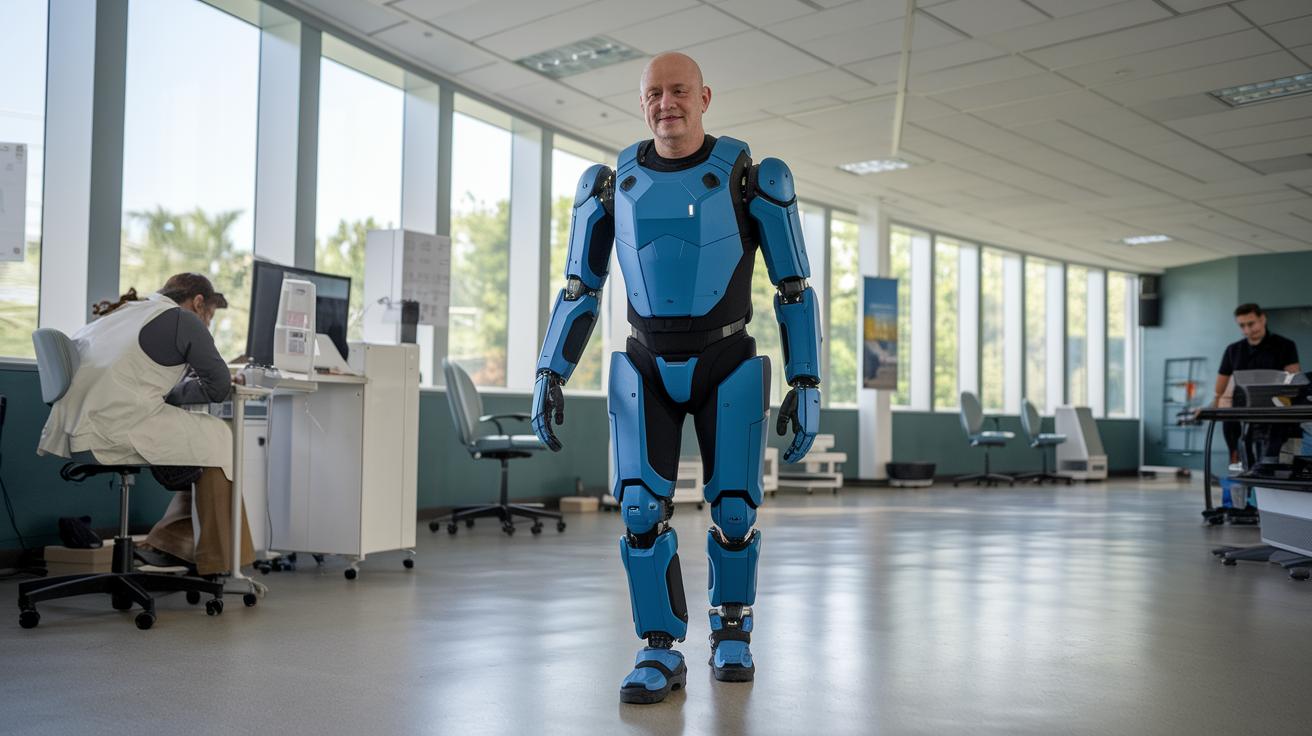
Stroke survivors using Georgia Tech’s AI exoskeleton have shared many stories about how it changes their lives. They say that practicing walking with the exoskeleton makes relearning how to walk feel easier and builds their confidence step by step. One patient mentioned, "Using the exosuit felt like a gentle push that made each step easier." They love the way the device helps their body move naturally, so just standing or moving forward doesn’t feel like such a big effort.
At a care facility in Hyderabad, where experts have been helping people for more than 15 years, patients receive personalized recovery plans in a calm, green environment. With a team of 250 specialists and 60 different services, the facility blends medical, physical, cognitive, vocational, and social care. Here, the exoskeleton is one part of a treatment plan designed to address challenges from strokes, Parkinson’s disease, muscle weakness in older adults, and even neurological issues in children. Patients often leave with inspiring stories of renewed hope and steady progress.
Key parts of these personalized recovery programs include:
- Accurate limb support wearable systems that offer reliable stability.
- Assistive limb retraining systems that help rebuild everyday movement.
- Neurorecovery device wearables that work hand-in-hand with a broad care team.
These personal accounts show that wearable exoskeletons aren’t just high-tech tools, they’re life-changing helpers that give patients the power to regain mobility and confidence with every step.
Benefits and Limitations of Robotic Stroke Rehabilitation Exoskeletons
These devices help people relearn how to walk by guiding movement and keeping muscles active so they don’t weaken. They support weight-bearing and help rewire the brain (a process called neuroplasticity, which means the brain can change and form new connections after an injury). One person shared, "This device gave me the strength to step confidently, even on uneven ground," which shows just how empowering it can be.
On the other hand, older versions of these support systems can be a bit clunky. They often require manual adjustments, and that can be tough when stroke survivors have unpredictable step patterns. This means these legacy systems might not easily adapt to everyday changes. New models that use smart technology (AI, or artificial intelligence, which means computers learning from data) solve many of these issues by cutting sensor mistakes by 75% and automatically adjusting as you move.
Key advantages include:
- Enhanced brain rewiring and better control of movement
- More balanced walking and improved ability to bear weight
- Greater independence in daily activities
However, there are still some challenges. These systems usually cost more, they add extra weight, and both patients and therapists need special training to use them properly. Plus, some centers may not offer access to these devices. So, while they bring many benefits, it’s important to weigh these practical issues when thinking about stroke rehabilitation.
Future Directions and Next-Generation Exoskeleton Advancements in Stroke Rehabilitation
Imagine a wearable device that not only helps patients learn to walk again but also connects with online health tools so therapists can check progress from afar in real time. Right now, many exoskeleton systems are showing promise for people with conditions like Parkinson’s, osteoarthritis, and even young patients. Engineers are working hard to make these devices even smarter by using software that lets different devices share data. This way, exoskeletons can talk to remote monitoring systems and adjust therapy on the fly, creating custom support for each stroke survivor, step by step.
Future work aims to build smaller, lighter devices with longer-lasting batteries so they can be worn all day without a break. There's also cool progress on adding virtual reality and augmented reality to these suits. Imagine a virtual world that guides your movements and makes every session feel more fun and personal. Overall, these new ideas are paving the way for digital rehab solutions that improve motion tracking and boost the power of robotic therapy, pushing stroke rehabilitation into exciting new territory.
Final Words
In the action, we saw how new exoskeletons boost stroke recovery with sensor arrays, adaptive controls, and AI-driven designs. The technology shakes up traditional methods, helping stroke survivors relearn movement faster and with more ease. Real patient stories and clinical trials remind us that science moves everyday lives. Future models even hint at remote monitoring and smoother adjustments. Today’s breakthrough wearable exoskeletons for stroke rehabilitation paint an inspiring picture for a more mobile tomorrow.
FAQ
What is the new breakthrough for stroke patients?
The breakthrough for stroke patients uses wearable exoskeletons with sensors and adaptive control algorithms. They help by promoting active movement and improving gait with precise, real-time adjustments that boost neural connectivity.
Can exoskeleton help stroke patients?
Exoskeletons help stroke patients by supporting proper gait and weight-bearing. They encourage active muscle movement and neural reconnection, making it easier to relearn walking and regain confidence.
How much does a rehabilitation exoskeleton cost?
The cost of a rehabilitation exoskeleton depends on the model and features. High-tech models can cost tens of thousands of dollars, with price variations based on manufacturer and system capabilities.
What are the new technologies for stroke rehabilitation?
The new technologies include AI-driven sensor arrays, adaptive control algorithms, and integrated software. These innovations enable precise, real-time movement tracking and adjustments that help improve stroke rehabilitation outcomes.

