
Have you ever wondered what it takes to reach space? In this post, we'll dive into the amazing story of the first man in space by looking at seven key moments along his journey. We start with Yuri Gagarin's bold flight, a simple command that lit up the world with excitement. Each step in his adventure opened the door to future space missions and reminded us that big, daring dreams can really change history. Get ready to explore the milestones that turned an out-there idea into a fascinating reality.
Yuri Gagarin: The First Man in Space and His Historic Orbital Flight
Yuri Gagarin made history on April 12, 1961, by becoming the first person to travel into space. He blasted off on Vostok 1 from the Baikonur Cosmodrome, marking one of the biggest moments in space travel.
The Vostok 1 had a round module about 7 feet (2 meters) wide, and it soared as high as 187 miles (301 kilometers) above Earth. In just 89 minutes, Gagarin circled the planet, proving that automatic systems (simple computer controls) could handle the tough tasks of a space mission. He even shouted "Poyekhali!", meaning "Off we go!", a small word that captured the thrill of venturing into the unknown.
At 27 years old, with experience as an industrial technician and test pilot, Gagarin took on this brave mission with calm and determination. The spacecraft’s automatic guidance system made sure everything ran on its own, setting a new standard for Soviet spaceflight. Every part of his mission showed a big leap in space travel, sparking global interest and paving the way for more crewed missions.
That one orbit was a giant step into the vast cosmos. Each moment of his flight brimmed with wonder, and even today, his journey makes us look up at the sky and dream of what lies beyond.
Early Life and Cosmonaut Training of the First Man in Space

Gagarin was born on March 9, 1934, in a tiny village called Klushino, Russia. In 1946, his family moved to Gzhatsk, where he discovered a love for math and science. Growing up during wartime, he even saw his hometown fall under enemy control for almost two years. Those tough times helped him build a strong sense of determination and resilience.
Before becoming the first man in space, Gagarin worked as an industrial technician. His interest in flying led him to study at the Orenburg Civil Aviation School and later at the Chkalov Flight School. In 1960, he was chosen as one of the first Soviet cosmonauts and put through a rigorous training program. He faced tough physical tests, including centrifuge runs (machines that spin to create strong force effects) and many parachute jumps. Each exercise was a way to get ready for the incredible challenges of space travel.
All these early experiences and hard work laid a solid foundation for his role in space history. Every challenge he met helped shape a path to his amazing journey, showing us that with courage and persistent practice, even the sky is not the limit.
Vostok 1 Spacecraft and Flight Profile of the First Man in Space
Gagarin's space journey now shows us some important technical details that shaped this breakthrough trip. The spacecraft had a round descent module (about 7 feet or 2 meters wide) connected to a service module packed with crucial instruments and engines. These parts worked together to run an automatic mission control system.
When the capsule reached roughly 7 miles high, Gagarin left it and used a parachute to descend safely in the Saratov area. The round design of the module, the role of the service module, and the careful ejection process all highlight the smart engineering behind this historic flight.
| Parameter | Value |
|---|---|
| Launch Date | April 12, 1961 |
| Cosmonaut | Yuri Gagarin |
| Module Diameter | 7 ft (2 m) |
| Peak Altitude | 187 miles (301 km) |
| Orbital Period | 89 minutes |
| Mission Duration | 1 hour 48 minutes |
Historical Significance of the First Man in Space
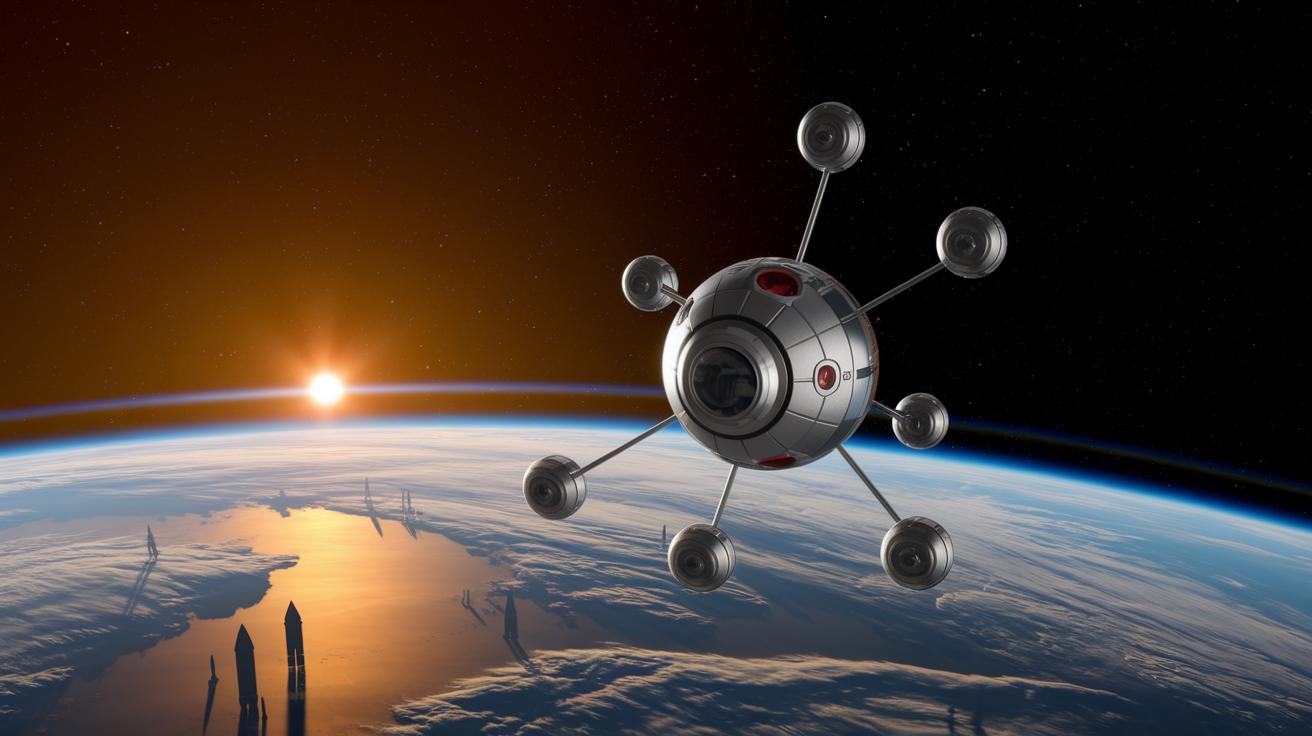
In 1961, Gagarin’s small, spherical spacecraft showed the world that automatic controls could safely run a mission. This simple fact rocked a world eager to see what human ingenuity could do.
At a time when tension was high around the globe, Gagarin’s flight proved that technology had the power to push our limits. It was a clear sign that even in the strange, low-gravity environment of space, machines could handle the challenge. That really surprised everyone watching from home.
Gagarin’s journey turned the Cold War space race into a fierce competition between the Soviet Union and the United States. People all over the world saw this test of technical skill not just as a win in space exploration but also as a display of national strength. It made it easier for everyone to see that space wasn’t just a faraway dream, it was a place we could reach.
The impact of his daring mission went well beyond science. It sparked lively debates about the future of space travel and encouraged new missions to go even further. Gagarin’s flight kicked off a new era of human space exploration, paving the way for the bold, innovative technology that followed.
Yuri Gagarin’s Legacy as the First Man in Space
Gagarin’s first flight on Vostok 1 still shines as a symbol of true bravery. He took a quick ride into orbit that showed the world what was possible. Even when he served as a backup on Soyuz 1, a flight that ended sadly, his impact on space exploration remains clear.
He risked everything to prove that people could venture into space, opening a new chapter for all of us. His mission sparked the imaginations of millions and encouraged countries to start their own space programs.
Gagarin’s life was cut short in a plane crash on March 27, 1968. This tragedy still leads many to wonder about the risks of pushing boundaries. Even though some details about his last days are still debated, his legacy continues to guide both astronauts and engineers.
His story shows that every small step in space travel can unlock major discoveries. Every new mission venturing into the unknown carries a bit of the spirit he left behind.
Final Words
In the action from the start, Yuri Gagarin, the first man in space, mounted a bold flight that reshaped human possibilities. His 89-minute orbital trip on Vostok 1 bridged the gap between dreams and science, showing us that even complex missions can inspire ordinary wonder. We explored his early life, intensive training, spacecraft details, and lasting influence. Gagarin’s legacy lights the way for today’s science discussions, proving that exploring the unknown can be both thrilling and deeply human.
FAQ
Who was the first man in space?
The first man in space is Yuri Gagarin, who flew on Vostok 1 on April 12, 1961, and completed an orbit around Earth. His flight set a historic milestone for human space exploration.
Was John Glenn the first man in space?
John Glenn was not the first man in space. He became the first American to orbit Earth, highlighting a separate historic achievement during the space race.
Who was the second person in space?
The second person in space was Gherman Titov, who orbited Earth soon after Yuri Gagarin and further paved the way for human space missions with his notable flight.
Who was the first woman in space?
The first woman in space is Valentina Tereshkova, who flew into orbit in 1963, paving the way for female participation in spaceflight and inspiring future generations.
Who was the first astronaut to walk on the moon?
Neil Armstrong became the first astronaut to walk on the moon during the Apollo 11 mission in 1969, marking a monumental achievement in the history of space exploration.
Was Laika’s dog still in space?
Laika, a stray dog launched on Sputnik 2 in 1957, did not survive the mission. She died in space shortly after launch, marking a somber moment in early animal spaceflight.
What is the “First Man in Space” movie about?
There isn’t a single definitive “First Man in Space” movie. Several films dramatize Yuri Gagarin’s historic flight and early human space endeavors, celebrating the spirit of exploration in different ways.
Who is Vladimir Komarov?
Vladimir Komarov was a Soviet cosmonaut and engineer who played a key role in early space missions. Tragically, he lost his life during a Soyuz spacecraft landing in 1967.
Who is Alan Shepard?
Alan Shepard, an American astronaut, became the first American in space with a suborbital flight in 1961, marking a significant milestone in the United States’ entry into human space exploration.
Who is Alexei Leonov?
Alexei Leonov was a Soviet cosmonaut renowned for performing the first-ever spacewalk in 1965. His groundbreaking extravehicular activity marked a major achievement in human spaceflight.