
Have you ever wondered what secrets lie just below our feet? Our Earth isn’t just a simple ball but a layered masterpiece, kind of like your favorite cake with different flavors in every layer. The outermost part is a thin, fragile crust, then comes a bubbling outer core, and finally a solid inner core, all of which hide clues about earthquakes, volcanoes, and more. By digging into these layers, scientists uncover hints about the hidden pressures and heat that shape our world. In this article, we’ll take a friendly ride through Earth’s interior, exploring what really makes our planet tick.
Composition and Structure of Earth’s Internal Layers
Think of our planet like a layered cake. Earth has four key layers that help us learn about everything from earthquakes to volcanoes. Scientists look at these layers to discover clues about the pressure and materials deep below us.
The top layer, called the crust, is a thin, brittle shell where we live. It’s made mainly of silica, aluminum, and oxygen. Under the waves, the crust might be only about 5 km thick, while on land it can be nearly 70 km thick.
Next comes the mantle, a huge layer of hot rock that moves very slowly because it’s under a lot of pressure. It feels almost like a thick liquid under extreme heat, which makes it very interesting to study.
Below the mantle is the outer core, a churning, liquid mass of molten iron and nickel. Its temperature is nearly as high as the sun’s surface! Deep inside, the inner core is a solid ball made of iron and nickel, standing in clear contrast to the swirling outer layers.
Each of these layers is unique. The crust is cool and brittle, the mantle is hot and flows slowly, the outer core is turbulent and liquid, and the inner core is densely solid. These differences help scientists understand the hidden forces that shape our world every day.
Crust Composition and Crust–Mantle Boundary
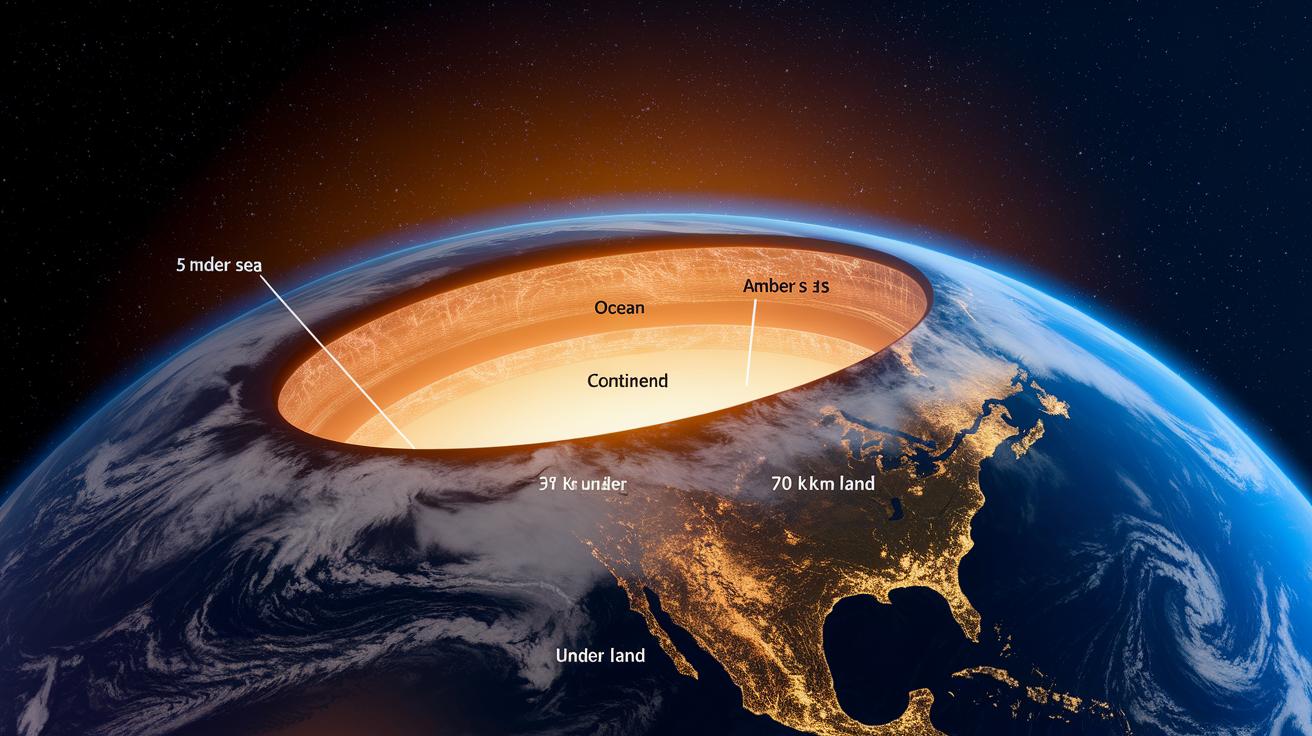
The Earth's crust is like the fragile outer shell we live on. It is made mostly from light materials such as silica (a common rock mineral), aluminum (a key metal), and oxygen (which helps bond many minerals). This layer can change in thickness quite a bit. Under the oceans, it averages around 5 km thick, while on continents it can be anywhere from 30 to 70 km thick. Think of it as the delicate skin of an apple, it protects what lies within and gives us clues about the structure beneath.
| Material/Measurement | Description |
|---|---|
| Silica (SiO₂) | Main mineral that forms most of the crust |
| Aluminum (Al) | Key secondary element in the crust |
| Oxygen (O) | Essential element for forming many minerals |
| Oceanic crust | About 5 km thick on average |
| Continental crust | Ranges from 30 to 70 km thick |
Right below the crust, you’ll find the Mohorovičić discontinuity, or Moho. This is the point where the lighter crust meets the denser mantle beneath. When seismic waves (vibrations moving through the Earth) pass through, they change speed at this boundary. This shift gives scientists a useful signal that helps them map the Earth's inner layers and plan safe drilling or research projects.
Mantle Thermal Dynamics and Convection Currents
Picture a layer that reaches almost 3,000 km beneath our planet's crust. This is the mantle, made up of silicate rocks rich in iron, magnesium, and silicon. Under the heavy pressure of the Earth and intense heat, the mantle doesn't behave like the rocks you see on the surface. Instead, it flows like a thick, slow-moving river of hot rock, continuously reshaping our planet.
Deep inside the mantle is a special zone called the asthenosphere, found between about 100 and 200 km down. Here, the heat is so high that it partially melts the rock (imagine a bit of softened chocolate), making it soft and flexible. Think of it like butter melting on warm toast, where the soft butter lets the toast slide easily. This flexible layer helps the outer parts of the Earth move over it, setting the stage for big shifts.
Heat rising from deep within creates convection currents. Warmer, lighter rock rises while cooler, heavier rock sinks in a never-ending cycle, much like stirring a thick stew where everything shifts around. These currents drive the movement of tectonic plates above, slowly shifting continents and lifting mountains. It’s a gentle yet powerful process that connects the intense heat below with the dynamic changes happening on Earth's surface.
Outer Core Properties and Magnetic Field Generation
The outer core is a liquid layer made mostly of iron and nickel. It sits about 2,880 km to 5,180 km below us. Unlike the solid inner core above or the rocky mantle below, this layer is molten, and that makes all the difference. It stores a lot of heat that powers many of Earth’s inner workings.
The heat in the outer core comes from radioactive decay (when elements like uranium and thorium break down and release energy). Think of it like a pot of boiling water, the heat causes the liquid metal to move in swirling, churning patterns. This movement helps carry heat upward through our planet.
All that motion is key to creating Earth’s magnetic field. As the metal flows, it generates electrical currents that, in turn, build up the magnetic field that protects us from dangerous solar radiation. And guess what? Over time, the magnetic field reverses, with the north and south poles swapping places every 200,000 to 300,000 years. This cycle gives scientists cool clues about what’s happening deep inside our planet.
Inner Core Formation and Core Dynamic Processes
Deep down inside Earth, there’s a solid inner core made mostly of iron and nickel. It’s about 1,220 km wide and is hidden deep below the surface, between roughly 5,180 and 6,400 km. The heat here is almost like having a bit of the sun’s fire in a tiny ball, reaching up to around 5,400 °C (or nearly 10,000 °F). At the same time, the pressure is more than three million times stronger than what we feel at the surface. This huge pressure keeps the inner core rock solid even though the heat might normally melt metals.
Over billions of years, as Earth slowly cools, the inner core forms bit by bit from its melted material. When this material freezes, it gives off extra energy known as latent heat (that’s the energy released when something changes from liquid to solid). This warmth helps stir up currents in the outer core, kicking off what we call the geodynamo, a process that creates Earth’s magnetic field. In simple terms, the gradual cooling and solidifying inside our planet not only builds the core but also powers the magnetic shield that protects us from harmful space radiation.
Seismic Interpretation Techniques for Earth’s Layered Structure
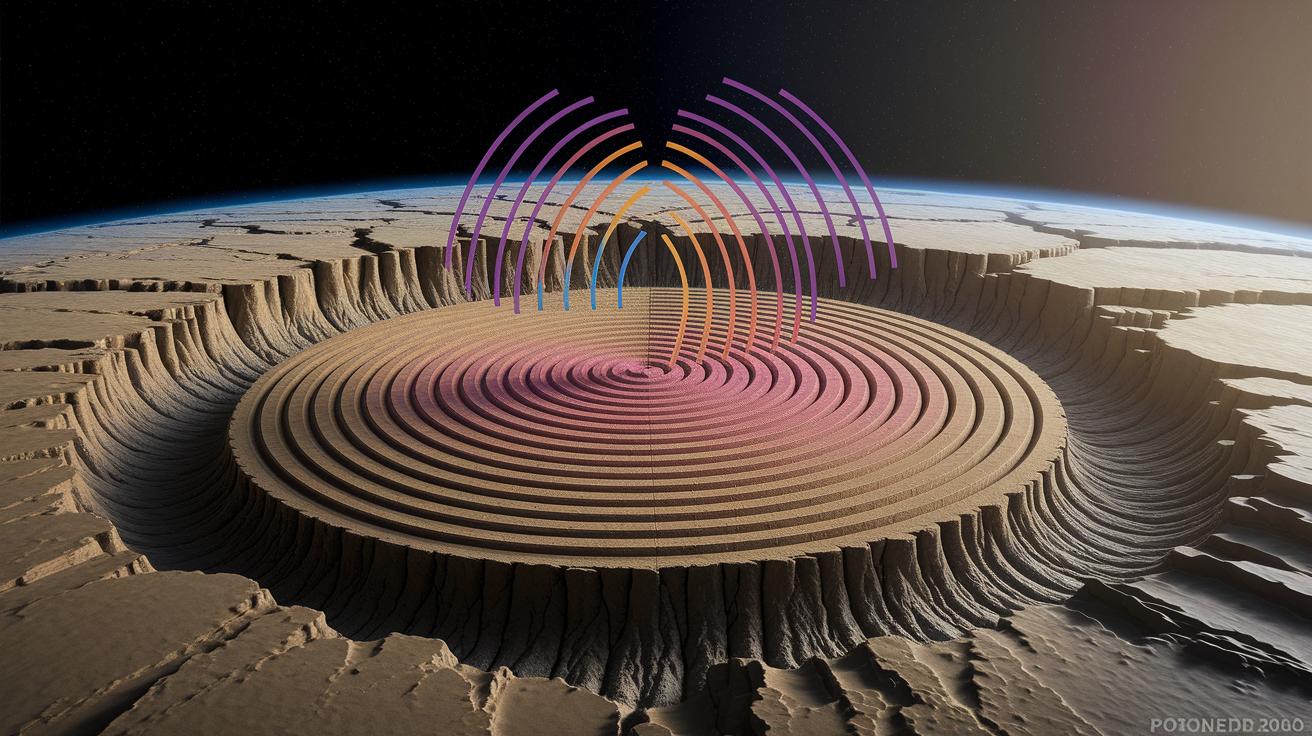
Seismic waves help us peek inside our planet. There are two main types: primary waves (P-waves) that move quickly through solids and liquids, and secondary waves (S-waves) that travel slower and only through solids. When these waves hit changes like the Moho or the boundary between the core and the mantle, they speed up or slow down, bending as they go. For instance, a P-wave might suddenly change pace as it leaves the crust and enters the mantle, giving scientists clear hints about what’s inside.
- P-wave speed jumps at layer borders
- S-waves vanish in liquid areas
- Waves bounce and bend at boundaries
- 3D imaging through tomographic inversion
Advanced methods like 3D seismic tomography take the time it takes for waves to travel and use that info to create detailed maps of Earth’s interior. Scientists collect data during tremors and follow how P- and S-waves move through different layers. This method helps them find spots that might be good for drilling by showing shifts in temperature and the mix of materials down below. It’s a bit like watching a giant clock work, each tiny change in the waves tells us how the parts fit together and work as one big machine. Whether in research labs or out in the field, seismic tomography is a strong tool for revealing hidden details about our ever-changing planet.
Visualizing Earth’s Layers with Diagrams and Models
Textbooks often show simple diagrams that give us a clear glimpse into what lies beneath our feet. These images map out each layer with everyday color cues, a thin blue line for the crust, a broad yellow section for the mantle, a swirling orange band for the outer core, and a compact red circle for the inner core. Imagine a diagram where every part is drawn to scale, much like a simple floor plan for a house.
Interactive 3D models and online simulators add a fun twist to these visuals. They let you see how the mantle moves slowly, like thick, warm rock sliding around, and how the core creates magnetic forces (the push and pull that makes compasses work). Picture spinning a digital Earth on your screen, clicking on the mantle to reveal animated currents and shifting boundaries between layers. It turns plain images into lively explorations of our planet's hidden workings.
Another cool thing is how standard labels help us learn better. We stick with easy-to-recognize color codes: red shows the inner core, orange marks the outer core, yellow stands for the mantle, and blue highlights the crust. Using these consistent colors makes it simple to link what you see with the written facts, so you can really grasp how our Earth is built.
Final Words
In the action, our discussion took us through Earth’s internal structure, from the crust and mantle to the outer and inner core. We examined how each layer works, the physical differences between solid and liquid zones, and how seismic tools map out these zones.
Breaking down complex science into clear visuals and models helped us see the striking differences across the layers of the earth. The insights remind us how even our planet shows layers of wonder in its inner workings.
FAQ
What does “Layers of the Earth atmosphere” mean?
The term “Earth’s atmosphere” refers to the blanket of gases surrounding the planet. It is not part of the interior layers, which include the crust, mantle, and core.
How can a drawing of Earth’s layers help kids understand its structure?
A drawing for kids typically shows a crunchy crust, a flowing mantle, a liquid outer core, and a solid inner core, similar to a layered cake, making the complex structure easier to visualize.
What defines Earth’s crust?
Earth’s crust is the hard, outer rock layer composed mainly of silica and oxygen. Its thickness can vary from a thin oceanic layer to a much thicker continental region.
What are the four basic layers of Earth?
The four primary layers are the crust, mantle, outer core, and inner core. Each layer differs in composition, temperature, and physical state, creating a dynamic internal structure.
How does the five-layer model of Earth differ from the four-layer model?
In the five-layer model, a fifth layer called the lithosphere is added. This rigid outer shell includes the crust and upper mantle, playing an important role in plate motion.
How is Earth often categorized into three layers?
A simpler model divides Earth into three parts: the crust, the mantle, and the core, with the core comprising both the outer and inner core as one central mass.
What does a seven-layer model of Earth include?
A seven-layer model expands on the basic layers by adding segments like the atmosphere, hydrosphere, and biosphere, offering a broader perspective of Earth’s overall structure.
Has the mantle ever been reached by scientists?
Researchers have not physically reached the mantle. Its properties are studied indirectly using seismic waves and other geophysical methods to understand the deep Earth.
What is the middle of Earth called?
The middle of Earth is known as the inner core, a solid metallic sphere primarily composed of iron and nickel that lies at the very center of the planet.
What role does Earth’s mantle play in the planet’s structure?
The mantle is a thick, hot rock layer beneath the crust. Its slowly moving material creates convection currents that help drive the shifting of tectonic plates.
What is the asthenosphere and why is it important?
The asthenosphere is a soft, partially melted region within the upper mantle. Its semi-fluid properties allow tectonic plates to move, influencing Earth’s surface activity.
How is Earth defined based on its internal structure?
Earth is a planet with a complex layered structure that includes a solid crust, a moving mantle, and a metallic core, all contributing to its dynamic surface and magnetic properties.