
Have you ever wondered if our warming world might bring about some bright changes? Scientists have noticed Earth's temperature rising from long before heavy industries took off. They use easy-to-understand models (simple tools that show future possibilities) to predict what our climate could look like by 2100. Their findings remind us that our everyday choices, like how we use energy, really count. In this article, we explore these ideas and see how smart actions today might lead us to a cooler, safer tomorrow.
Global Climate Change Projections and Future Warming Scenarios
The Intergovernmental Panel on Climate Change, or IPCC, started back in 1988 with help from the World Meteorological Organization. They gather lots of data over many years to see how global temperatures have changed. By comparing today’s conditions to those before industrial growth (the pre-industrial period), they help us understand where we stand and what might come next.
Recent reports, like the Sixth Assessment Report from 2021, tell us that human actions are the main cause of warming since the mid-1900s. In simple terms, burning fossil fuels has released extra greenhouse gases (gases that trap heat) that are heating the planet. Future scenarios use ideas called Shared Socioeconomic Pathways (SSPs) to imagine different outcomes depending on how society changes and how much we emit. Current studies project a median warming of about 2.7°C by 2100, but there’s some wiggle room. For instance, temperatures could be a bit higher or lower, with a 33% chance of reaching 3.1°C or more and a 10% chance of hitting 3.4°C or above.
These warming trends are a big wake-up call for scientists and policymakers. They remind us that acting now to cut emissions can really shape our future and keep our world on a safer path.
| Scenario | Projected Δ°C by 2100 |
|---|---|
| SSP1-2.6 | ~1.5°C |
| SSP2-4.5 | ~2.7°C |
| SSP3-7.0 | ~3.3°C |
| SSP5-8.5 | ~4.4°C |
Regional Climate Change Projections and Spatial Variability
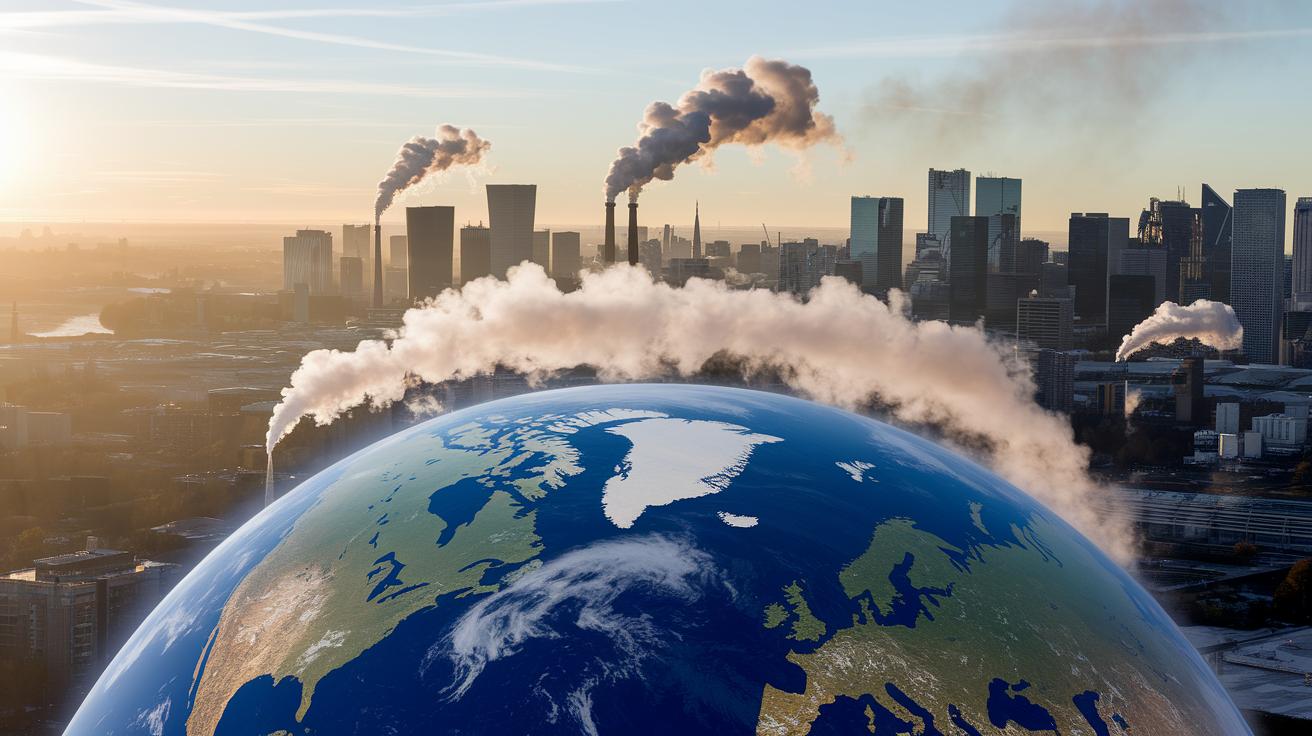
Since the 1970s, our planet has been heating up faster because of more greenhouse gases from factories, cars, and power plants. Imagine turning a small candle into a big bonfire, this boost in emissions has sped up warming across many regions.
In the polar areas, the warming acts in its own unique way. In the Arctic, temperatures could rise almost twice as fast as the global rate under some climate plans. Meanwhile, Antarctica is slowly heating up over time, much like simmering water on a low flame. These differences show that even nearby areas can heat up in very different ways.
Cities feel the heat too. Urban spots with lots of concrete and little green space trap extra warmth, a bit like an oven. When you walk through a busy city on a hot day, you might notice how the buildings and roads seem to make everything even hotter. This extra urban warmth is important to understand as we plan for communities that can handle a changing climate.
Sea-Level Rise Projections and Coastal Impact Scenarios
Global ocean levels are rising, mostly because ice in Greenland and Antarctica is melting. By 2100, experts expect the sea level to go up between 0.3 meters and 1.1 meters. Think of it like slowly filling a bathtub, bit by bit, the water level goes up until it changes everything. Even modest increases, according to detailed forecasts using future planning methods, could really change our everyday lives.
By 2050, we might see the sea level rise by about 0.2 meters to 0.5 meters. That might not seem like a lot, but for coastal communities, it could mean more flooding and extra stress on buildings and infrastructure. Plus, issues like shoreline erosion (where the coast gradually wears away) and saltwater getting into freshwater supplies make low-lying areas even more vulnerable. If you want to dive deeper into these risks, check out this link: effects of climate change.
Here’s a quick look at what this means:
| What to Expect | Impact |
|---|---|
| Global rise by 2100 and mid-century (2050) estimates | Changing coastlines and higher risk for communities |
| More frequent and intense coastal flooding | Greater danger for homes and infrastructure |
| Threats to low-lying megacities and island nations | Increased vulnerability and potential displacement |
| Shoreline erosion and saltwater intrusion into aquifers | Challenges for freshwater supplies and land stability |
Extreme Weather Event Projections and Uncertainty Analysis

AI-enhanced models tell us that our climate could cross the 1.5 °C mark within the next 10 to 15 years. These systems mix lots of observed data with computer simulations (detailed digital experiments) to show how rising temperatures might lead to more extreme weather events. For example, one study found that if current trends continue, there’s more than a 99% chance that global warming will outpace 1.5 °C over the long run, even if we stopped emissions by 2050. It’s like getting a sneak peek into a future with hotter, more unpredictable weather.
As the planet heats up, expect to see more heatwaves, heavy rains, and long droughts. Experts point out that higher temperatures may mean longer periods of intense heat and fiercer rainstorms. Imagine a day that starts off warm but then turns into a scorching afternoon with sudden, heavy rain. These kinds of events are predicted to become common around the world, and studies show that keeping up current emissions will only make these extremes worse.
Scientists also compare results from different models with natural weather patterns to check how reliable the forecasts are. Even though each model shows a range of possible outcomes, the overall message is clear, extreme weather events will continue to increase. While there is some uncertainty in the predictions, most experts agree that we’re headed for more intense heatwaves, heavier rains, and tougher droughts, making careful planning more important than ever.
Methodologies and Model Comparison in Climate Change Projections
Today, predicting future climate uses a blend of models that work together to give us a clearer picture of what might come. Scientists combine many simulation outputs using what’s called CMIP6 multi-model ensembles. This helps even out the quirks of individual models. They also use scenario modeling techniques that use common ideas about the future, like the SSP scenario. Traditional models give a solid start, while newer machine learning approaches (smart computer programs that learn from data) tackle tricky issues, like showing gravity waves (ripples in the atmosphere) in a more realistic way. All together, these combined outputs let researchers compare different simulations side by side, giving them a better overall view of possible climate futures.
Lately, new ways of comparing these simulations have shown differences both across places and over time. Techniques such as prediction accuracy reviews help scientists figure out where old methods might miss spots and where innovative machine learning can boost reliability. By comparing models step by step, researchers learn how warming might change at different speeds and affect regions in unique ways. This blended approach not only makes forecasts more accurate but also helps build a detailed picture of climate change projections. In truth, it’s a promising way to stay ahead of upcoming challenges and fine-tune policies based on a clearer view of our environmental future.
Long-Term Climate Outlook: 2050 to 2100 Environmental Scenarios

By 2050, many climate models expect the Earth’s temperature to rise about 1.5°C compared to the times before heavy industry. Think of it like heating water in a pot; the rise happens slowly, but each little increase brings noticeable changes. Studies based on years of careful measurements and computer simulations show that this warming picks up pace as time goes on. Imagine a clock that gets louder with each tick as an important moment approaches, that extra noise reflects how our predictions become trickier as natural weather changes mix with extra greenhouse gases (gases that trap heat).
Looking ahead to 2100, the story splits into two different outcomes. In a low-emission future, temperatures might stick close to the 1.5°C mark, hinting at fewer abrupt climate shifts. On the other hand, if we continue with high emissions, the temperature could climb above 3°C. Picture two gardens: one that gets just the right amount of care and another that struggles under a harsh, unyielding sun, the health of the gardens is much like what our climate might face. The latest assessments from the AR6 report show that these temperature trends will affect our ecosystems and the global carbon cycle (the way nature uses and moves carbon), highlighting how our actions, plus natural variability, shape the future.
Precipitation Projections and Water Resource Forecasts
Across the globe, weather patterns are changing in surprising ways. Recent models show that areas near the poles and in tropical regions will likely see heavier rain more often. Think of it like a sudden, heavy downpour on an otherwise dry day, unexpected yet powerful. On the flip side, subtropical regions may experience drier conditions as shifts in how and when the monsoons hit change the usual seasonal flow. In short, while some places might get extra rain, others could end up fighting to save every drop.
Looking at water supplies, things seem a bit worrying for places with already dry climates. Researchers predict that regions in arid and semi-arid zones could face serious water shortages by 2030, even as more rain falls in other areas. As the timing and volume of rain become harder to predict, this uncertainty could challenge farming, city planning, and water management systems. Imagine a local reservoir that sometimes overflows after a massive storm and then stays nearly empty for long periods. This kind of back-and-forth might lead to conflicts over water, pushing communities and decision-makers to adjust their plans quickly.
Final Words
In the action of breaking down today’s scientific insights, we covered global temperature outlooks, regional warming details, and coastal risks from rising seas. We also touched on how extreme weather events might change and compared different model methods to show mid- and end-century outlooks.
These climate change projections help paint a clear picture of both warming trends and the evolving water resource challenges ahead. Every piece of the analysis reminds us that understanding these shifts can guide us toward smarter, safer choices for our future.
FAQ
What are climate change projections for 2100?
The projections for 2100 suggest global warming could reach around 2.7°C above pre-industrial levels, with some scenarios showing rises over 3°C depending on future emissions policies.
What are climate change projections for 2050?
The projections for 2050 indicate that global temperatures could be roughly 1.5°C above pre-industrial levels, with moderate warming expected under many future development scenarios.
What do interactive climate change projection maps show?
Interactive climate change maps display future warming scenarios based on different models, highlighting regional temperature differences and potential coastal impacts.
What information do global warming prediction maps for 2050 provide?
The global warming prediction maps for 2050 illustrate temperature increases across regions, revealing variations due to local factors and emission patterns, and helping guide planning efforts.
What do the IPCC climate change projections indicate?
The IPCC projections confirm that human activities drive warming using multiple model outputs, providing standardized estimates that help guide policies and future emission reduction efforts.
What are the climate change predictions for 2030?
The climate change predictions for 2030 suggest modest warming increases with observable shifts in regional weather patterns and more frequent heavy rainfall events in some areas.
What are examples of past wrong climate change predictions?
Some past predictions overestimated the immediacy of catastrophic warming or underestimated natural variability, which newer models now refine with improved data and methods.
How hot will Earth be in 2050?
Earth is expected to be about 1.5°C warmer by 2050 above pre-industrial averages, with regional variations influenced by local emissions and natural factors.
Will we survive until 2050?
Climate projections focus on temperature trends and risks rather than survival; careful management of emissions and adaptation strategies can help communities cope with climate challenges.
Where in the US might people be safest from climate change effects?
Some forecasts suggest that northern regions and areas less prone to flooding or extreme heat may face lower risks, though all regions will experience some impacts from climate change.