Is 2025 about to reshape our world in ways we never expected? With a record-breaking camera at the Vera C. Rubin Observatory (a special place where we watch the stars), a lunar landing by Blue Ghost, and exciting new steps in HIV treatment, progress is speeding up.
Scientists are stretching the limits in space, health, and energy, areas that touch every part of our daily lives. These breakthroughs might soon offer fresh answers to long-standing problems and light up a bright path to the future.
Ever wondered if this could be the year everything changes? Read on and see why 2025 might just be a turning point in how we understand our universe.
Key Science Discoveries to Watch in 2025
2025 is starting to look like a year of amazing scientific breakthroughs. Researchers are pushing the limits in space, health, and energy with discoveries that could change the way we see the world. They are carrying out bold experiments and using new, fast-moving technologies that open our eyes to what is possible.
- The Vera C. Rubin Observatory now has a 3.2 billion-pixel camera working in Chile.
- On March 2, Firefly Aerospace’s Blue Ghost made history by softly landing on the Moon for the first time in a commercial mission.
- New treatments for HIV are on the rise, with experimental antibody infusions and twice-yearly lenacapavir injections helping in both remission and prevention.
- De-extinction work is moving forward with projects like a thylacine artificial womb, creating mice with mammoth-like traits, and even efforts to revive dire wolves.
- Renewable energy sources beat coal by generating over one-third of the world’s electricity in the first half of 2025.
- Google’s new quantum echoes algorithm can predict molecular behavior 13,000 times faster than older methods, offering a big leap in speed.
These breakthroughs are broadening our view of science and showing us new ways to solve old problems. Each discovery works on a specific challenge, from unlocking the mysteries of dark matter (an unseen part of the universe) to better treatment for diseases, while also building the foundation for tomorrow’s innovations. It’s exciting to see how ideas from different fields can come together and drive progress as we move further into this remarkable year.
Astronomy and Space Exploration Discoveries 2025
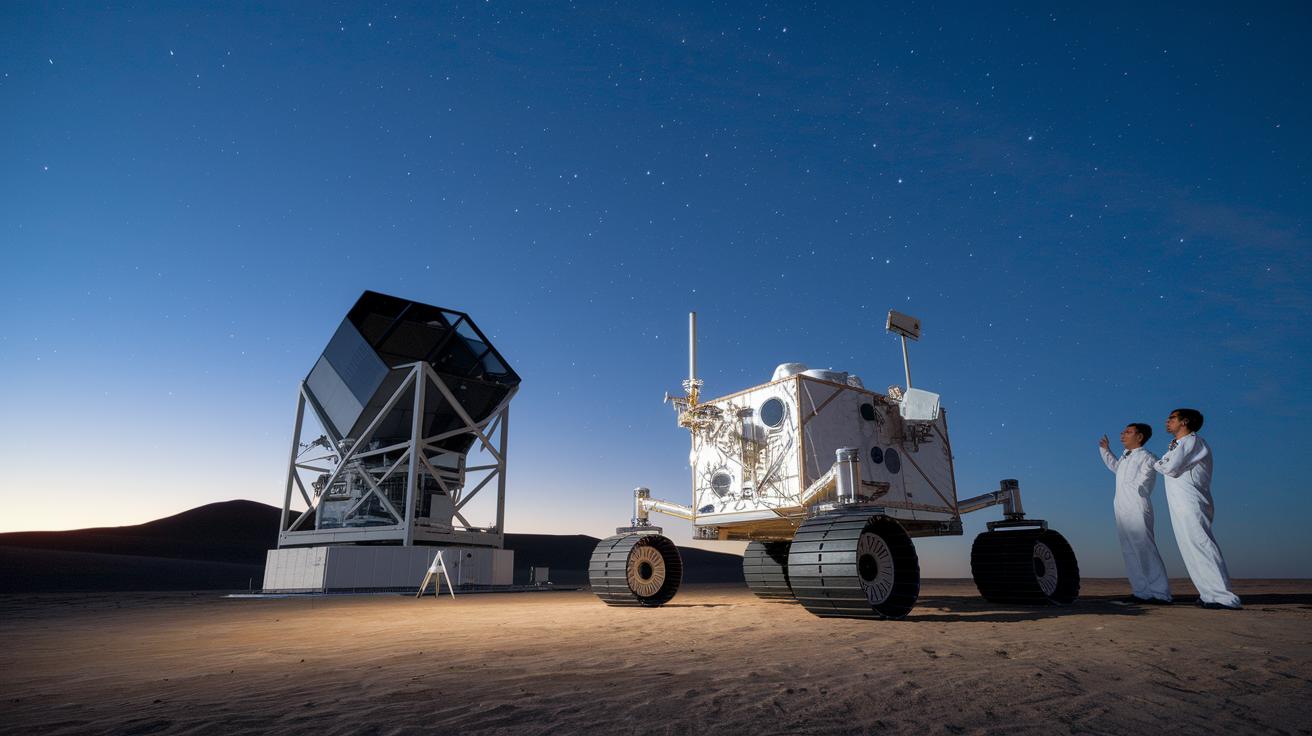
Space studies are picking up speed as new missions and fresh tools change our view of the universe. Modern telescopes and lunar explorers from private companies are opening up new data on asteroids, dark matter (the invisible stuff that holds galaxies together), and strange signals from space. Public space agencies and private teams are teaming up to help us learn more about the cosmos.
Vera C. Rubin Observatory Discoveries
The Vera C. Rubin Observatory now has a giant 3.2 billion-pixel camera. It’s expected to capture around 5 million asteroids, including 100,000 that approach Earth. Its deep surveys will also help scientists study dark matter and record fast cosmic events like bursts of light from gravitational waves (ripples in space caused by massive objects). This new level of detail is set to change how we track stars and other objects in space.
Commercial Lunar Landings
Firefly Aerospace’s Blue Ghost lunar lander achieved a gentle landing on the Moon on March 2, 2025. The mission carried new and clever equipment to study the lunar surface and test technology for private space travel. This success is paving the way for more space ventures beyond Earth.
In another exciting development, Venus Aerospace’s Rotating Detonation Rocket Engine shows great promise. It can reach speeds between Mach 4 and Mach 6 (about 4 to 6 times the speed of sound), which might cut flight times dramatically – maybe even making a trip from Los Angeles to Tokyo in under two hours. By boosting power while using less fuel, this engine could change how we travel both commercially and globally.
ESA-JAXA’s BepiColombo mission is also making waves by sending two orbiters to Mercury. These orbiters are busy mapping Mercury’s surface, checking out its thin atmosphere, and exploring its inner layers. Some scientists even wonder if Earth might be surrounded by a kind of empty space ring, a theory that could explain odd details in the leftover heat of the Big Bang and shift our models of the universe.
Key Medical Discoveries 2025
In 2025, healthcare research is making some really exciting strides. Experimental treatments like neutralizing antibody infusions have helped people with HIV experience remission for months or even years. And lenacapavir injections have just earned the World Health Organization's endorsement for HIV prevention after US approval. These new approaches are changing the way we manage infections, giving doctors and patients a fresh dose of hope for long-term health.
A small study by uniQure is showing promising results for Huntington's disease. Their gene therapy works by targeting the real cause of the illness instead of simply easing the symptoms. Early trials suggest that this treatment may slow down the disease, making it a hopeful step toward better care for neurodegenerative conditions.
In July 2025, a record-setting event captured worldwide attention when the oldest baby ever was born from an embryo that had been frozen since May 1994. This remarkable outcome highlights advances in reproductive health and hints at the vast potential of long-term embryo preservation. It’s a breakthrough that has both scientists and the public buzzing with excitement.
Research into a unique toothpaste made from keratin-based, hair-derived ingredients is also taking center stage. This substance creates a dense, crystal-like layer that repairs tooth enamel and protects exposed nerve channels. Early studies indicate that this innovation could make routine dental care more effective by reducing sensitivity and boosting overall oral health.
| Therapy/Discovery | Target Condition | Status | Notable Outcome |
|---|---|---|---|
| Neutralizing Antibody Infusions | HIV | Experimental | Remission for months to years |
| Lenacapavir Injections | HIV Prevention | WHO-Endorsed | Biannual dosing |
| CRISPR Sickle Cell Therapy | Sickle Cell Disease | Post-Approval Trials | Reverses symptoms |
| uniQure Gene Therapy | Huntington’s Disease | Early Trial | Slows progression |
3 new science discoveries 2025: Bright Future Ahead

Scientists are making big strides with CRISPR-based therapies. After their early success treating sickle cell, they are now trying gene editing (techniques that change DNA in a very precise way) to help with type 1 diabetes, some cancers, and high cholesterol. One study found that edited cells made proteins that could help control blood sugar. In simple words, small changes in genes are showing that treating problems at their starting point can really change how treatments work.
In early 2025, research into bringing back extinct species took bold steps. In January, scientists used an artificial womb to revive the thylacine. By March, they engineered mice to show traits of the woolly mammoth. Then in April, teams managed to bring back the American dire wolf, which had been gone for more than 10,000 years. Each of these advancements depended on careful genetic reprogramming and smart design, showing that gene editing might one day bring lost species back to life.
These new discoveries are also opening up the field of synthetic biology, where scientists improve organisms for jobs like cleaning up the environment and boosting industrial processes. As researchers use gene editing in new ways, they also take time to discuss ethical questions and set strong safety rules. This progress is lighting the path to a future where biotechnology not only beats diseases but also reshapes life and nature in incredible ways.
Renewable Energy and Environmental Discoveries 2025
In the first half of 2025, solar panel costs dropped a lot. This change allowed clean energy to provide over 33% of the world's electricity for the first time, overtaking coal. Picture the gentle hum of these panels as they turn sunlight into power, slowly reshaping our power systems with cleaner, more sustainable energy.
Recent changes in environmental rules have also made a big impact. The US EPA removed rules from more than 30 environmental acts and even began the process to cancel the 2009 Endangerment Finding (a rule linking greenhouse gases to risks for public health). These moves show a fresh way of thinking about protecting our planet, while also offering new chances and challenges as leaders try to balance growth with care for the environment.
There are also exciting advances in new, sustainable materials. Nobel-winning Metal Organic Frameworks (advanced materials made of metal and organic compounds) have stepped out of research labs into real-world test projects for gas storage and even helping deliver medicine. Meanwhile, Japan Airlines has started using a special sharkskin-inspired coating on the wings of its Boeing 787-9 planes. This clever innovation cuts down on drag, improves fuel efficiency, and lowers emissions, setting a new standard for green aviation.
Quantum Computing and Materials Discoveries 2025

Google’s new quantum echoes algorithm is now showing fresh experimental data on how molecules react. It uses special patterns in qubits (the tiny building blocks of quantum computers) to copy natural vibrations in molecules. Imagine a simulation resembling a classic double-slit experiment that gives detailed predictions as temperatures change.
They also improved error correction by adapting the tuning in superconducting circuits (small electronic systems that need very low temperatures) to cut down on thermal noise. Tests have revealed that qubit lifetimes have more than doubled, which means the system makes far fewer mistakes. It’s like having an instrument that automatically adjusts itself to stay in perfect tune, even if conditions get a bit bumpy.
Outdoor pilot projects are now using MOF applications to capture live pressure and temperature data. These systems not only trap carbon more efficiently but also enhance how precisely drugs are released. Picture a sponge-like material that, when it gets colder, catches gas molecules 15% better than before.
Upgraded detector arrays in high-energy experiments are using finely tuned calibration methods to clearly separate real signals from background noise. Experiments show that noise can be reduced to as little as 0.01% errors, opening up new opportunities to study mysterious cosmic particles. It’s much like a sensitive camera that sharpens its focus to capture the faintest light in the deepest dark.
Modern Biology and Ecological Discoveries 2025
A new caterpillar species, known as the Bone Collector, is capturing scientists’ attention. It cleverly uses the bones of its prey as a disguise, blending into its surroundings almost perfectly. Even though this insect makes up only about 0.1% of moth and butterfly species, its unique behavior reminds us that nature still holds many mysteries.
Orcas have been showing some unexpected and playful behaviors this year. Researchers have seen these smart mammals using kelp (a type of seaweed) to massage one another, and even sharing what they call “tongue kissing.” These surprising interactions might help us understand how social behaviors develop in wild animal communities.
Oyster mushrooms are stepping out of the lab and into technology in a big way. Scientists found that these fungi can produce bio-electrical signals (small, natural sparks of electricity) strong enough to control a robotic arm. This bionic arm has already been used to play music, recite poetry, and even paint self-portraits, opening new doors for mixing biology with robotics.
Recent studies on Toxoplasma gondii, a parasite present in many human brains, suggest it might influence our choices. Research indicates that people infected with this parasite could become more impulsive and take more risks. It’s a reminder that even tiny organisms can have a big impact on how we act.
Archaeologists in Austria have uncovered a 280-year-old mummy that was treated with an unusual embalming method. The process involved using wood chips, small twigs, fabric, and zinc chloride, applied through a unique rectal procedure. This rare discovery gives us a fresh look at historical medical practices and cultural rituals.
Final Words
In the action, this article covered major breakthroughs across space, medicine, genetic research, energy, quantum computing, and modern biology. We looked at everything from the latest lunar landings to gene editing and unexpected ecological findings, each revealing how science is reshaping our world. New science discoveries 2025 show us that even the tiniest breakthrough can spark big changes in everyday life. Keep exploring and stay curious, every new fact adds a spark to our understanding of the future.
FAQ
Q: What major scientific discoveries and inventions were made in 2025?
A: The major scientific discoveries in 2025 span astronomy, medicine, genetics, renewable energy, quantum computing, and biology. For example, the Vera C. Rubin Observatory cataloged millions of asteroids while commercial lunar landings advanced our space capabilities.
Q: What are the top medical breakthroughs in 2025 and 2026?
A: The top medical breakthroughs include HIV antibody infusions that led to remission, biannual lenacapavir injections for prevention, promising gene therapy for Huntington’s, and innovative trials that set new clinical milestones toward improving health outcomes.
Q: What unique genetic and de-extinction discoveries emerged in 2025?
A: Genetic research in 2025 brought CRISPR-based therapies and new gene treatments for common conditions, alongside de-extinction advancements like an artificial womb for thylacines and mice engineered with mammoth traits, showing bold strides in bioengineering.
Q: How were space exploration achievements advanced in 2025, including NASA’s contributions?
A: In 2025, space science surged through the Vera C. Rubin Observatory’s detailed asteroid surveys and the Blue Ghost lunar landing, while NASA and its partners collaborated on projects that boosted our understanding of celestial bodies and space phenomena.
Q: What unexpected or quirky scientific and genetic findings were reported in 2025?
A: Quirky discoveries in 2025 featured surprising animal behaviors, such as groundbreaking predation in orcas, and even oyster mushrooms creating bio-electrical signals to control a bionic arm, highlighting science’s fun and unforeseen side.
Q: What breakthrough was honored as the Science Breakthrough of the Year 2024?
A: The Science Breakthrough of the Year 2024 celebrated advances like Google’s ‘quantum echoes’ algorithm that ran molecular predictions far faster than older methods, setting the stage for many of 2025’s cutting-edge innovations.