
Have you ever wondered if one person's mind could completely change the world? Albert Einstein did just that. In one amazing year, he turned our ideas about time, space, and energy upside down. His bold ideas kicked off spirited debates and set science on a new path that still touches our lives today. As you read on, you'll see how his work continues to guide and inspire scientists, helping us see the world in fresh, unexpected ways.
Overview of Albert Einstein’s Major Discoveries
In 1905, Einstein had his miracle year. He released several papers that flipped our ideas about space, time, and energy on their head. His work introduced a whole new way of looking at the world, sparking lively debates and lighting up the path for future research in both theory and experiments.
- Special Relativity (1905) – explained that the laws of physics stay the same for all observers moving at a constant pace.
- Mass–Energy Equivalence (E=mc², 1905) – showed that mass and energy are just two forms of the same thing (kind of like different sides of the same coin).
- Brownian Motion Analysis (1905) – described the random, jiggling movement of tiny particles in fluids.
- Photoelectric Effect Theory (1905, Nobel 1921) – revealed how light can kick electrons out of materials, which helped us understand modern electronics.
- General Relativity (1915) – painted gravity as the bending of space around massive objects.
- Cosmological Constant (1917) – added a twist to the equations to help keep the idea of a steady universe.
- Bose–Einstein Condensate Prediction (1924) – anticipated a bizarre state of matter that happens at temperatures almost at absolute zero.
Later on, Einstein spent time trying to bring all the forces of nature together into one neat theory. His deep reflections on science continue to inspire and challenge researchers even today.
Albert Einstein’s Special Relativity Breakthroughs
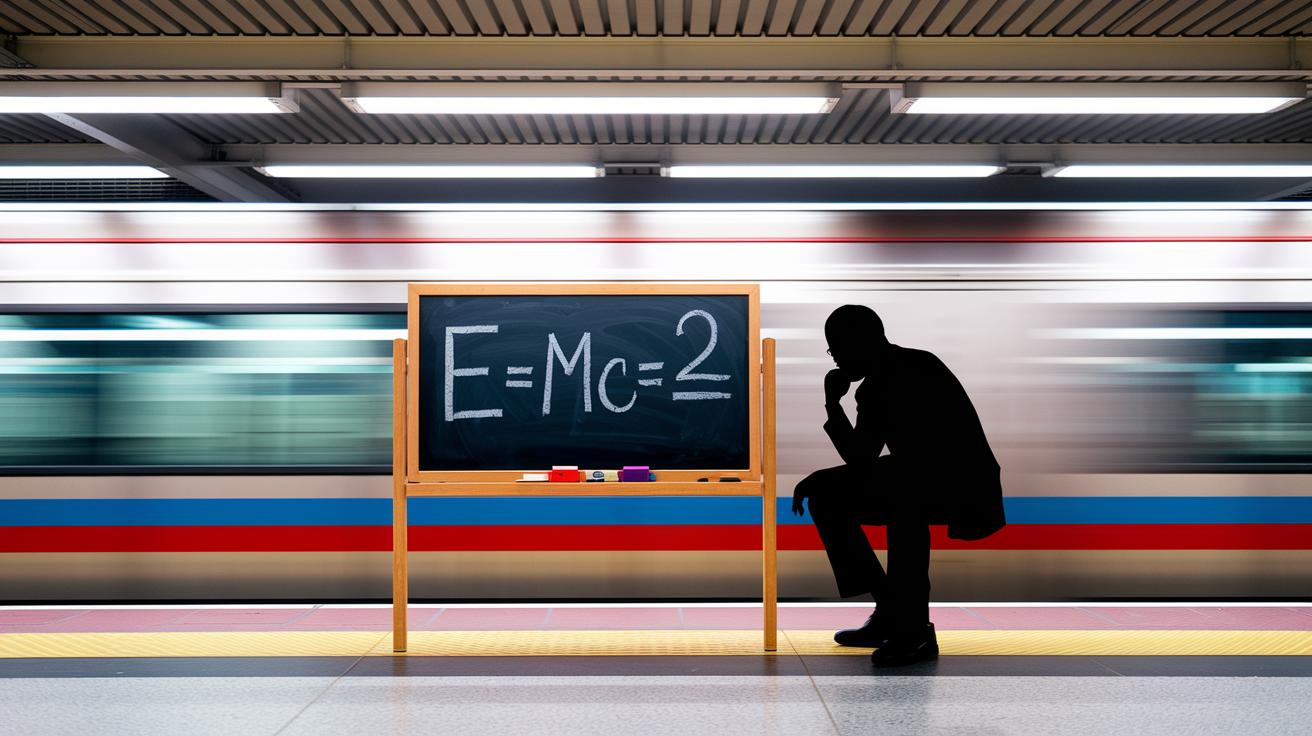
Einstein started with two big ideas. First, he said that no matter how you move, you always see light traveling at the same speed. Second, the rules of physics work the same whether you’re standing still or moving at a steady pace. These ideas completely flipped our old notions that time and space were fixed and unchanging. Imagine riding a fast train and noticing that your watch seems to tick a little differently, that’s a small taste of just how revolutionary his theory is.
With these ideas, Einstein found the famous equation E = mc². This means that mass (the amount of matter in something) is really just a concentrated form of energy. He used clever math called Lorentz transformations (a way to show how measurements like time and distance change when you’re moving) to put all the pieces together. Here’s a fun thought: if you could turn the mass of a tiny paperclip entirely into energy, the explosion would be amazingly huge.
Einstein’s ideas changed the way we look at motion. They challenged the old Newtonian mechanics and gave us a fresh look at how particles behave when they’re moving really fast. Today, we see these principles in action, from the inner workings of particle accelerators to breakthroughs in nuclear studies. It’s a reminder of how science can make us look at everyday things, a ticking watch or a speeding train, in completely new ways.
Albert Einstein’s General Relativity Innovations
Back in 1915, Einstein changed the way we think about gravity. Instead of a force pulling things together, he explained that gravity happens because heavy objects bend the fabric of space (imagine space as a soft, stretchy sheet). Big objects like planets and stars twist this sheet, causing paths of moving things, even light, to curve. This neat idea mixed simple shapes from geometry with the physical pull of the universe.
Bending of Light in 1919 Solar Eclipse
In 1919, during a solar eclipse when the sun was hidden, Arthur Eddington led a team to watch how starlight bent as it passed near the sun. They found that the stars didn’t appear where they usually do, showing that light changes direction in a strong gravitational field, just as Einstein had predicted. This discovery amazed scientists everywhere, giving clear, visible proof that space itself can bend.
Gravitational Wave Prediction and Confirmation
Einstein also had another brilliant idea in 1916: gravitational waves. These are tiny ripples moving through space when huge cosmic events happen, like two massive objects colliding. Then, in 2015, an experiment called LIGO caught these ripples from two colliding black holes, boldly confirming Einstein’s prediction.
Even today, scientists keep finding evidence that supports his ideas. They measure something called gravitational redshift (this is when light stretches to longer colors in a strong gravity field) and observe frame dragging (which is when spinning objects twist the space around them). All these findings help confirm Einstein’s theories and drive even more research into the true nature of gravity.
Einstein’s Photoelectric Effect and Quantum Contributions

For a long time, people thought light was just a smooth, continuous wave. But scientists ran into a puzzling problem: sometimes, light of a certain color (wavelength) could knock electrons off a metal, while other colors, even when very bright, did nothing. Imagine trying to splash water to knock toys off a table, it just wouldn’t work the way you expect. This odd result left researchers scratching their heads and led them to rethink their ideas about light.
Einstein came along and suggested that light isn’t just a wave; it’s made up of tiny packets called photons. He came up with the formula E = hf. Here, E stands for the energy in one photon, h is Planck’s constant (a tiny number that links energy to a light wave’s frequency), and f is the frequency of the light. This idea showed why only light above a certain frequency had enough energy to free electrons, clearing up the mystery that older theories couldn’t solve.
This discovery helped set the stage for what we now call quantum mechanics. It has had a big impact on modern technology like photodetectors and has changed how scientists think about the tiniest pieces of light.
Einstein’s Brownian Motion Analysis and Atomic Theory Support
In 1905, Einstein came up with a model that explained how tiny particles in liquids move. He showed that these little bits are constantly being bumped around by surrounding molecules. As the temperature rises, the particles jostle more because the molecules start moving faster. It’s a simple idea that connects what we can see with the hidden dance of tiny particles.
Later on, a scientist named Perrin did some experiments by watching these small particles in a liquid. His findings matched Einstein’s predictions perfectly. This was a big deal because it proved that matter is made up of atoms, supporting the idea that everything around us is built from these tiny building blocks. It also paved the way for a field called statistical mechanics, which uses chance to explain how groups of particles behave.
Einstein’s Bose–Einstein Predictions and Unified Field Theory Pursuit

Bose–Einstein Condensate Prediction
Einstein worked with S. N. Bose to explore how tiny particles (quantum particles) behave and to predict a brand new state of matter. Back in 1924, Einstein suggested that if you cool atoms almost to the coldest temperature possible (nearly absolute zero), they would start acting like one big, unified wave. Imagine cooling a gas so much that every particle seems to dance in perfect, harmonious rhythm. This striking idea was confirmed experimentally in 1995, and it opened a whole new window into understanding how matter acts under extreme conditions.
Unified Field Theory Quest
From the 1920s to the 1950s, Einstein chased a big dream: to find one set of math rules that could explain all the forces in nature. He wanted to blend gravity (the force that keeps you on the ground) with electromagnetism (the force that makes a light bulb shine) into one complete theory. Picture it like solving a puzzle where every piece, from the pull on your feet to the spark in a bulb, fits perfectly together. Even after years of intense work, this puzzle still hasn’t been solved. But Einstein’s quest continues to spark curiosity and inspires scientists to keep searching for a simple, all-encompassing explanation of how the universe works.
Einstein Discoveries Confirmed: Experiments & Applications
For decades, Einstein's ideas have been backed by experiments that really show how his theories work. Early tests helped us see how light bends when it swings by massive objects, and later, instruments like LIGO picked up tiny ripples in spacetime that confirmed gravitational waves. One of the most exciting moments came with the Event Horizon Telescope capturing the shadow of a black hole. It’s amazing how modern tech lets us take a peek into the hidden corners of the cosmos.
| Experiment | Year | Confirmation Details |
|---|---|---|
| Light Deflection | 1919 | Eddington’s eclipse measurements showed spacetime bending |
| Gravitational Waves | 2015 | LIGO picked up ripples from colliding black holes |
| Frame Dragging | 2004–2022 | A study of a neutron star and white dwarf confirmed frame dragging |
| Black Hole Imaging | 2019 | The Event Horizon Telescope captured the first image of a black hole’s shadow |
The Scientific Legacy of Albert Einstein’s Discoveries

Albert Einstein’s groundbreaking work set the stage for modern physics. His ideas reshaped how we view nuclear energy, quantum tech (tiny particles you can’t see with your eyes), and even the universe. His theories guide experiments and have helped create many of the practical technologies we use every day.
Before anyone knew his name, Einstein scribbled his ideas on scraps of paper. It’s amazing to think those quick notes eventually transformed our understanding of everything around us. For more details, check out Impact of Scientific Breakthroughs on Society.
Final Words
In the action, we explored Einstein’s groundbreaking work that reshaped physics, from his early 1905 breakthroughs in special relativity and mass–energy equivalence to his later insights on gravity, quantum theory, and Brownian motion. His work on the photoelectric effect and Bose–Einstein predictions kept us intrigued by how simple ideas can change our view of the world. The blog reviewed albert einstein discoveries that still spark curiosity and fuel ongoing research, reminding us that science continues to light up our everyday lives with wonder.
FAQ
Q: What is Albert Einstein famous for?
A: Albert Einstein is famous for his groundbreaking work in physics. His theories, including special and general relativity and the photoelectric effect, reshaped how we understand time, space, and energy.
Q: What did Albert Einstein invent or discover?
A: Albert Einstein discovered key scientific principles that transformed physics. He developed special relativity, explained the photoelectric effect, analyzed Brownian motion, and later introduced general relativity, all of which redefined our view of the universe.
Q: Can you share a brief biography of Albert Einstein, including his childhood, birthplace, and education?
A: Albert Einstein was born in Ulm, Germany, where his curious nature showed early. Growing up, he pursued studies in physics and mathematics, setting the stage for his later revolutionary contributions to science.
Q: What was Albert Einstein’s first major contribution?
A: Albert Einstein’s first major contributions emerged during his 1905 miracle year. He published influential papers on special relativity, E=mc², the photoelectric effect, and Brownian motion that challenged established ideas in physics.
Q: What is known about Albert Einstein’s death?
A: The death of Albert Einstein on April 18, 1955, marked the loss of a pioneering mind. His legacy lives on as his theories continue to influence modern science and inspire curiosity around the globe.

