
Have you ever stopped to think about how we figure out the size of our planet's skin? It might sound simple, but Earth covers about 510 million square kilometers, and that number isn’t easy to work out. Scientists imagine Earth as a slightly squashed ball (kind of like a football that's been pressed just a bit) so they can get a grip on the math. This idea helps us see why even the tiniest curves can change the bigger picture of our world. In this post, I'll walk you through what goes into measuring Earth’s surface and why every little curve matters.
Earth’s Total Surface Area Overview
Earth’s total surface area is about 510 million square kilometers (197 million square miles). You often hear this number in science classes and discussions because it counts every bit of land and water that makes up our planet. Think of it like drawing a giant floor plan for a huge building, every room (or square kilometer) matters.
To figure out this number, scientists treat Earth as an oblate spheroid (a shape that's a bit squished at the poles and wider at the middle because of its spin). Instead of using a simple formula for a perfect sphere, they adjust for the gentle flattening at the poles. This method gives us a solid starting point for more detailed calculations in other studies. Isn't it neat how even small tweaks in shape can change our understanding of the whole planet?
How Earth’s Shape Affects Surface Area
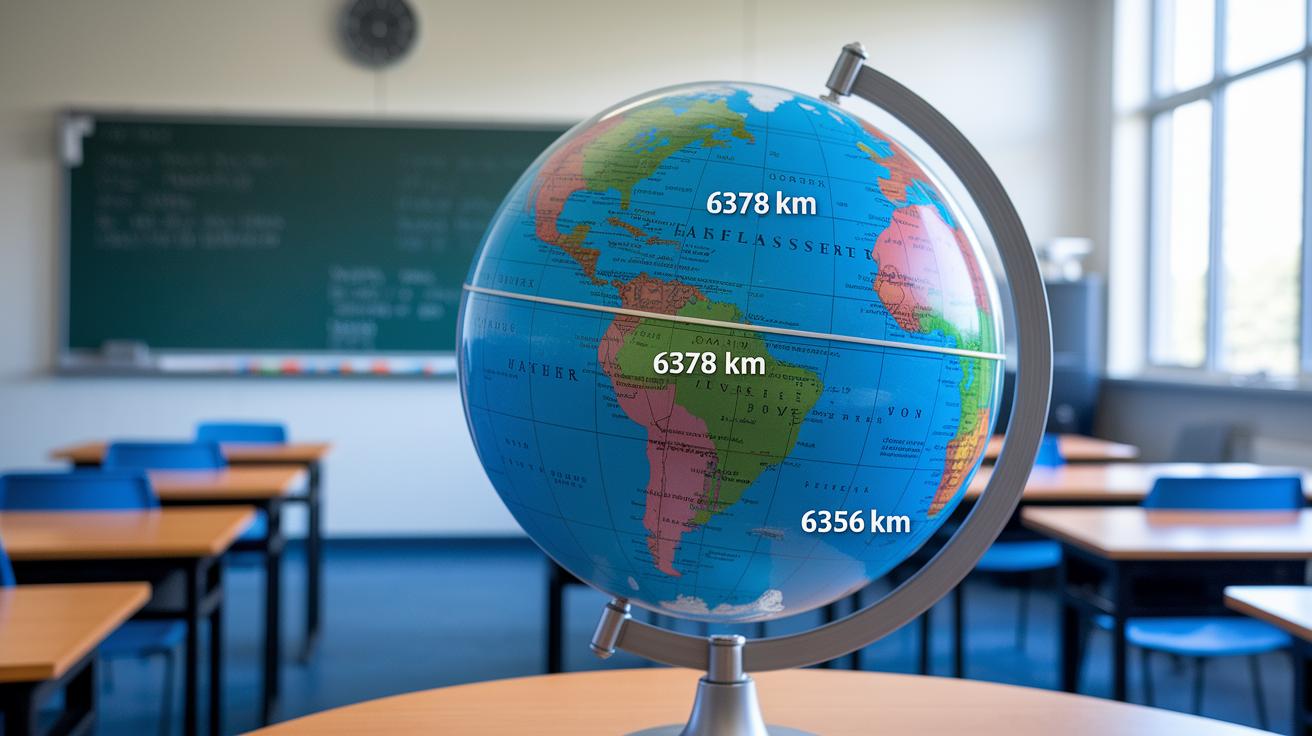
Earth isn’t a perfect ball. Instead, it has a squished shape at the poles and a bit of a bulge in the middle. This happens because our planet spins, which gives a slight push out at the equator. Think of it like spinning a water balloon, the middle expands as it spins. Because Earth isn’t exactly round, scientists have to do some extra math to measure its outer parts accurately.
Today, experts work with two main numbers. The equatorial radius is about 6,378 km (3,963 mi), and the polar radius is a little smaller at 6,356 km (3,950 mi). They adjust old formulas (which were meant for a perfect sphere) using these numbers. By considering both the gentle flattening at the poles and the nicer bulge at the equator, scientists can calculate Earth’s surface area with great precision.
Mathematical Approaches to Computing Surface Area
Have you ever thought about how we figure out Earth's surface area? Since our planet is curved, different math is needed for different shapes. For a perfect sphere, we can simply use the formula 4 π r². This works great for a rough idea, but Earth isn’t a perfect ball.
When we factor in Earth’s equatorial bulge and polar flattening, things get more interesting. Scientists use an approach that blends the equatorial radius (the distance from the center to the middle) with the polar radius (the distance from the center to the pole). This method refines the simple formula to capture the real size of our planet.
Spherical Surface Area Formula
For a true sphere, the math is pretty clear: 4 π r² does the job. Because it uses just one radius (the distance from the center to the surface), it makes the calculations pretty straightforward.
Example snippet: Imagine saying, “Ancient astronomers used this basic formula to study the skies, even if they didn’t know about Earth’s slight bulge.”
Oblate Spheroid Calculation Method
Since Earth is a bit squashed at the poles, scientists switch to an ellipsoid formula. This method mixes both the equatorial and polar radii and adds a few correction factors to account for how distances change with latitude.
Example snippet: Think of it like averaging the heights of rolling hills to understand the landscape; that’s how experts average Earth’s radii for a more precise measurement.
| Approach | Formula |
|---|---|
| Sphere | 4 π r² |
| Oblate Spheroid | Ellipsoid formula |
The sphere formula is great for quick, rough guesses, while the ellipsoid method is essential for mapping Earth’s surface with accuracy.
Surface Area Distribution Between Land and Water
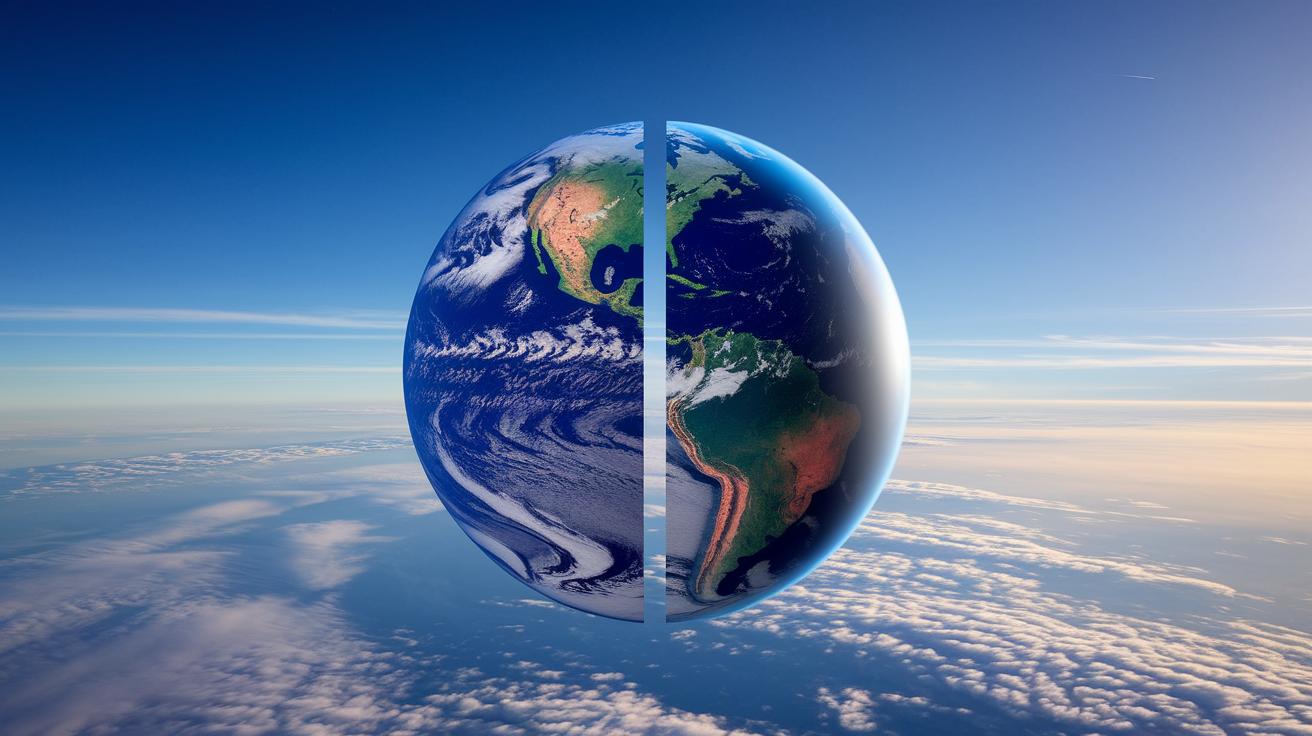
Earth’s surface is divided into two main areas: land and water. Most of our planet is covered by water, while a smaller part is made up of continents, islands, and other land types. Scientists tell us that roughly 29.2% of Earth is land, and 70.8% is water. These numbers help us understand everything from where natural resources are found to how weather and climate work.
This balance affects weather patterns, ocean flows, and even the way people have built their homes over time. It’s amazing to think about how much of our world is water and the role it plays in our everyday lives.
| Type | Area (million km²) | Percentage |
|---|---|---|
| Land | 148.94 | 29.2% |
| Water | 361.07 | 70.8% |
History of Measuring Earth’s Surface Area
Early on, smart thinkers laid the groundwork for how we understand the size of our planet. Aristotle, for example, used simple observations of the sky and shadows to guess that Earth's circumference was around 73,225 km (45,500 mi). Then, around 250 B.C., Eratosthenes took things a step further. He used basic angle math (where angles help measure distances) by comparing shadows in different places. His approach was so good it came within about 1% of what we measure today.
Next, in the 17th and 18th centuries, science got a big boost. Better telescopes and new tools allowed researchers to see the Earth’s shape much more clearly. They also started using refined math models to explain why our planet is a bit squished. This period was all about progress, with new instruments making observations more reliable.
Today, modern geodesy (the science of measuring Earth) uses satellites and GPS (systems that pinpoint where you are) to get incredibly precise numbers. These advanced methods even account for the slight flattening at the poles and the bulge at the equator. It’s amazing to think that the work of ancient scholars has led to today’s super accurate, satellite-driven measurements.
Final Words
In the action, we traveled through Earth’s overall exterior measurement, revealing its vast number of about 510 million square kilometers (197 million square miles).
We unpacked how Earth’s slightly squashed shape factors into these figures and broke down the math behind it, along with a look at land versus water spread.
We also stepped back through time, from early trigonometry to modern satellite techniques.
This clear view of our planet's surface area of Earth leaves us feeling excited about science and ready to learn more.
FAQ
Frequently Asked Questions
What is the surface area of Earth (in km², mi², m², and cm²)?
The surface area of Earth is roughly 510 million km² (197 million mi²), about 5.10×10^14 m², or 5.10×10^18 cm². This measurement uses an oblate spheroid approach to include both land and water.
What is the formula used to calculate Earth’s surface area?
The surface area of a perfect sphere is calculated as 4πr². Since Earth is an oblate spheroid with differing equatorial and polar radii, scientists use a modified ellipsoid formula for better accuracy.
What is the volume of Earth?
Earth’s volume is around 1.08×10^12 km³. This calculation reflects Earth’s oblate shape and provides insight into the overall size and internal structure of our planet.
Is it hotter at the equator?
Regions near the equator tend to be warmer. Strong, direct sunlight heats these areas more effectively compared to higher latitudes, where the sun’s rays strike at a less direct angle.
What is the hottest planet?
Venus is the hottest planet, with surface temperatures nearing 465°C. Its thick atmosphere creates a strong greenhouse effect, keeping its surface much hotter than any other planet.
What is the coldest planet?
Neptune is often considered the coldest planet due to its great distance from the sun, resulting in extremely low temperatures, even though it occasionally shows some internal heat.
What does a surface area of Earth map show?
A surface area map of Earth displays the total area of 510 million km², clearly illustrating the split between oceans and continents along with various geographical features in a simple visual format.
How does Earth’s surface area compare within the Solar System?
Earth’s surface area is unique with its balanced mix of land and water. Other celestial bodies like Mars, Jupiter, and various moons have very different surface characteristics, reflecting their distinctive sizes and compositions.