
Have you ever wondered what it takes to build a space station? China’s space station is putting on a pretty impressive show up there. Its main piece is the Tianhe module, which launched in April 2021. Think of Tianhe as the busy control center for crewed missions (missions where astronauts go to space) in low Earth orbit (the area around our planet).
The station is made of three modules working together to support life in space for long stretches. It’s a big step forward in our journey into the cosmos. In this post, we explore what makes China’s space station stand out and why it’s a game changer in space exploration.
Comprehensive Overview of the Chinese Space Station Tiangong
China’s Tiangong space station is a striking three-module hub that orbits in low-Earth space. It all began on April 29, 2021, when the Tianhe core module launched into orbit. This core module, which is 18.1 meters long and weighs 22 metric tons, acts as the station’s command center. It keeps up to three astronauts safe during six-month missions, and even allows for three more during crew changeovers. Imagine witnessing Tianhe’s entry into orbit, its impressive build marking a bold step into advanced space research.
Built on lessons from earlier projects like Tiangong-1 in 2011 and Tiangong-2 in 2016, this station takes the best ideas of the past and turns them into a design focused on safety, efficiency, and long-duration life support. Those earlier modules proved key technologies by testing them out before they reentered Earth’s atmosphere in 2018 and 2019. This careful experimentation paved the way for what Tiangong is today.
China’s journey in space has seen some truly memorable milestones. The Shenzhou-5 mission in October 2003 had astronaut Yang Liwei orbit Earth for 21.5 hours over 14 orbits, proving that humans could thrive in space. Then, in October 2016, the Shenzhou-11 mission carried two astronauts for 30 days, showcasing better life-support systems and comfortable living spaces. This steady progress feeds into Project 921’s Phase III, which pushes for independent scientific research, stronger defense capabilities, and a boost in national pride. Today, Tiangong isn’t just a spacecraft, it’s a thriving center of technological progress and a major marker in China’s space exploration journey.
Historical Development of China’s Orbital Program Leading to Tiangong

China embarked on its crewed space adventure with the Shenzhou-5 mission on October 15, 2003. Yang Liwei spent about 21.5 hours in space, flying 14 orbits around Earth, and his journey captured the imagination of the nation.
In 2016, the Shenzhou-11 mission took two astronauts on a 30-day stay, testing new life support systems (the equipment that keeps astronauts safe) and paving the way for even longer missions.
Before these long missions, China launched two test modules, Tiangong-1 on September 29, 2011, and Tiangong-2 on September 15, 2016. These early projects helped develop the important technologies that now make up the Tiangong space station.
A setback occurred in July 2017 when a Long March 5 launch didn’t go as planned, delaying the Tianhe core module until April 2021. During this period, space fans tracked every moment through CNSA’s live feeds and third-party apps, comparing China’s progress to that of the International Space Station.
For example, one live feed showed the spacecraft maneuvering in real time like a live sports match, offering viewers a clear look at both its challenges and successes.
Architectural Design and Module Configuration of the Chinese Space Station
Imagine the Tianhe module as the heart of the space station. It serves as the command center, life support system, and living quarters all in one tidy package. With a 4.2-meter diameter, an 18.1-meter length, and weighing 22 metric tons, it’s a marvel of efficient design. Fun fact: inside Tianhe, every drop of water is recycled, about 70% is recovered, much like reusing ingredients in your favorite recipe.
Next to Tianhe are the Wentian and Mengtian science modules. Both of these are roughly 17.9 meters long and weigh around 23 metric tons each. They attach using special ports that let them dock flexibly, kind of like adding new rooms to your cozy home in space.
Inside these modules, the layout is all about safety and comfort. The crew has bunks that measure 2 by 1 meter for some much-needed rest after long days of research. There’s a small galley to prepare meals using space-friendly methods and a hygiene area to keep daily routines in check. Workspaces, including lab benches and a control center, ensure the crew can easily conduct their experiments and maintain the station.
The station also boasts innovative environmental systems. Its regenerative Environmental Control and Life Support System (ECLSS) makes sure most of the water is reused, while air quality is maintained using solid-state CO₂ scrubbers (devices that remove carbon dioxide) and O₂ electrolysis (a method that splits water into oxygen and hydrogen). This blend of robust design and smart technology shows how modern space habitats are built to thrive even in the vast vacuum of space.
Construction Timeline and Assembly Milestones of Tiangong
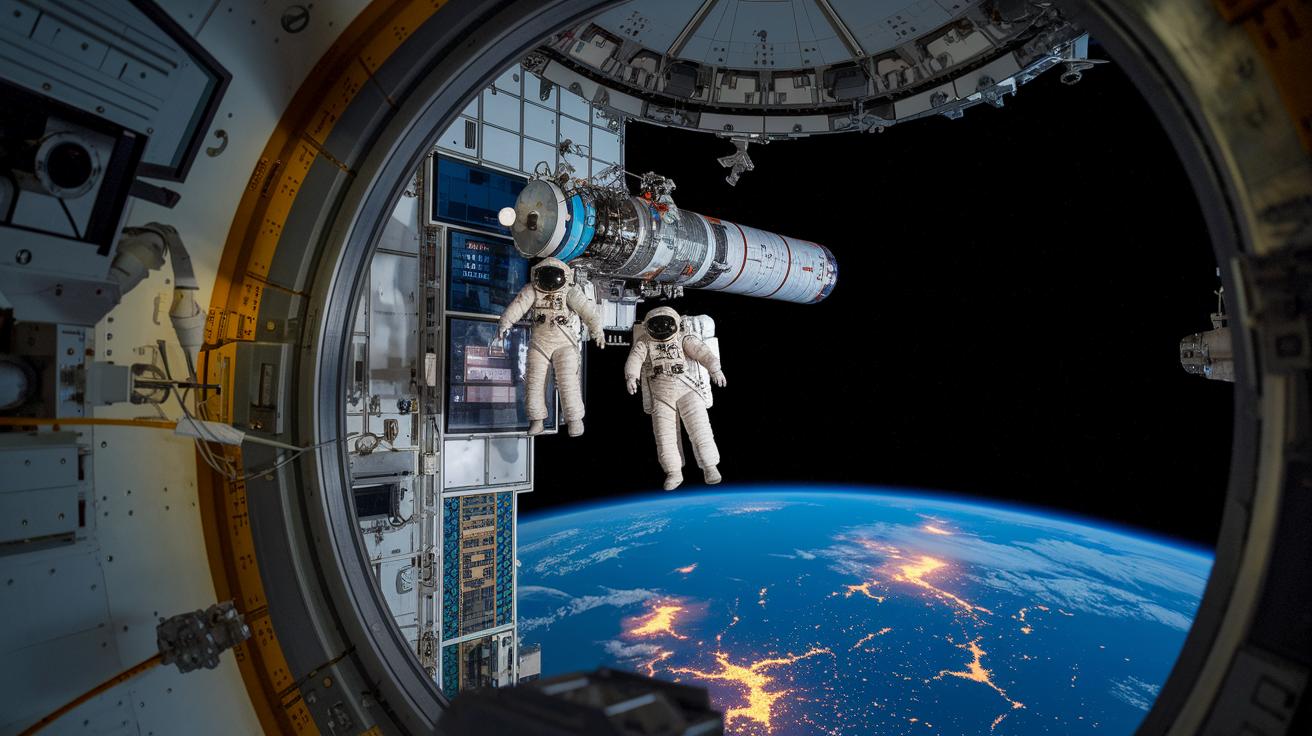
On April 29, 2021, China shot the Tianhe core module into orbit using a Long March 5B rocket. This launch kicked off the building of a space station designed for cutting-edge research and life-support advances.
Just a month later, on May 29, 2021, the Tianzhou-2 cargo spacecraft linked up with Tianhe. It delivered 6.5 metric tons of supplies, imagine quickly stocking a high-tech space home with everything needed for long missions.
Then on June 17, 2021, the Shenzhou-12 crew made its first docking. Ground stations and public tracking apps (tools that let everyone follow space movements) kept a close eye on the process, letting curious folks and researchers see the progress live.
From September 2021 to November 2022, the station grew even more. The Tianzhou-3 cargo craft, along with the Shenzhou-13 and Shenzhou-14 missions, brought new pieces to the puzzle. In July 2022, the Wentian science module arrived, and by November 2022, the Mengtian science module was in place. Each addition came with unique features, labs for fluid physics, biotech, and even cold atoms (extremely chilled particles used in research), pushing the station’s capabilities to new heights.
Every step was tracked carefully, from launches to dockings to module additions. This detailed timeline not only shows off the impressive build but also serves as a real-time record of the station’s journey and its many life-support upgrades.
Life Support Systems and Crew Living Quarters on the Chinese Space Station
Before launching a mission, engineers made sure that over 70% of the station's wastewater gets reused. This clever step makes the life support system almost self-sufficient and shows how far we've come compared to older methods.
The space station uses smart design and reliable systems to handle long trips in space. It cleans wastewater in a way that's a bit like your home’s water filter, recycling about 70% of it. Meanwhile, special devices clear out carbon dioxide (the gas we breathe out) and split water to create fresh oxygen. This mix of techniques keeps the air clean and safe for the crew.
The sleeping quarters are simple but cozy. Each bunk measures around 2 meters by 1 meter, set up for three astronauts on long missions, and can even hold up to six during crew exchanges. There are a few thoughtful touches as well, a small exercise bike and a treadmill help keep muscles strong in the absence of gravity. There's also a kitchen for freeze-dried meals and a special hygiene module that reclaims grey water, showing careful planning in every detail.
| System | Function |
|---|---|
| Water Recycling | Recovers 70% of water for reuse |
| Air Renewal | Uses CO2 scrubbers and O2 electrolysis to clean the air |
| Crew Lodging | Houses 3 long-term, 6 during crew transitions |
Scientific Research and Experiment Modules aboard the Chinese Space Station

The Chinese space station’s science modules are designed to push the limits of what we know about space. In the Wentian module, you’ll find labs dedicated to fluid physics and combustion (how liquids move and flames burn) in microgravity (almost no gravity). Imagine trying to cook when fire behaves completely differently! This setup gives scientists a unique place to explore basic physics in ways that can’t be done on Earth.
Then there’s the Mengtian module, which is all about space biology. Scientists study how plants grow, how tiny organisms (microbes) behave, and how diseases might spread in space. One cool experiment tracks how plant roots try to anchor themselves in weightlessness, offering clues about the future of farming beyond Earth.
The station also features a cold atom lab where atoms are cooled down to temperatures so low their movements nearly stop. This lets researchers peek into the strange world of quantum physics (the science of incredibly small things) and could help improve super-precise tools like gyroscopes that guide spacecraft. Plus, an astrophysics payload is busy catching cosmic rays, those high-energy particles from outer space, broadening our view of the universe.
Ongoing biomedical tests are also part of the mission, exploring issues like bone density loss and how cells grow differently in space. Together, all these experiments not only boost our basic scientific knowledge but also pave the way for new technologies and health solutions for long-term space travel.
Global Collaboration and Strategic Implications of the Chinese Space Station
China’s space station is more than just a science lab in space, it’s a meeting point for countries to work together and share ideas. The Chinese space agency has invited 18 nations to send experiments (devices or tools used to study science) onboard, making it a melting pot of cultures and research. This teamwork is extra important because once the International Space Station (ISS) is retired, China’s station might be the only home in space for astronauts. That means people from different countries can share their science discoveries while China gains a bit of a diplomatic boost.
One cool technical fact is how the station is built. Its solar panels provide about 100 kW of power (enough energy, for example, to light up many homes) to keep experiments running and systems in check. Even though its living space is much smaller, about 110 cubic meters compared to the ISS’s 388 cubic meters, every inch is used wisely. This shows that smart design can make a big difference in space research and international comparisons.
There’s also an interesting twist with export-control rules. These rules limit docking by non-Chinese spacecraft, which has kicked off lively talks about who gets to control and govern space stations. At the same time, these challenges give China a chance to set up a strong network of ground stations. This network helps support shared research and better satellite tracking, all of which strengthens China’s role in global space affairs.
chinese space station: Soaring in Stellar Success

The future of this space station is looking bright. There are plans to add a new science module weighing 30 metric tons (a metric ton is about 2,200 pounds). This module, about the size of a small house in space, will hold special instruments for deep-space telescopes. It could let scientists capture very dim starlight and study our universe in ways we haven’t seen before. Imagine peeking into the far reaches of space with a tool this mighty. Really cool, right?
Another exciting idea comes from the Tianjin Institute. They want to develop an inflatable habitat extension of about 50 cubic meters (a space roughly the size of a large room). This new space will give astronauts and researchers more room to live and work. It means they can perform experiments in a more comfortable area. On top of that, a robotic servicing arm is also planned. Its job will be to fix satellites, helping the station run smoothly and cutting down on any delays.
There are also plans for automated cargo freighters. These self-operating ships will bring supplies to the station without the need for a person to drive them. Keeping the station food and tools stocked will make research go on without any hiccups. Plus, engineers are testing prototypes for habitats that might travel to Mars or the Moon. Such testbeds will let scientists check life-support systems in space’s very weak gravity (microgravity), which is key for long trips across space.
In truth, the station is designed to grow with new discoveries. It uses a modular system, meaning new parts can be added as technology gets better and research needs change. This approach ensures that the station remains flexible and ready for all the challenges of tomorrow.
Final Words
In the action, the article traced vital milestones of the chinese space station, exploring its clever design, crew facilities, and experimental labs. It led us through the assembly timeline, from the first launches to modern modular research areas.
It also shed light on international teamwork and cutting-edge plans for future upgrades. The clear account makes today’s science accessible, engaging our curiosity and highlighting our ongoing quest to learn more every day. Each milestone proves that scientific progress is a collaborative effort that encourages us all to think big.
FAQ
Tiangong space station vs ISS
The comparison shows that Tiangong is built with modern Chinese technology and a compact design for shorter missions, while the ISS is a larger, multinational platform supporting longer continuous habitation.
Chinese space station problem and stranded
The discussion around Chinese space station problems or being stranded often refers to temporary technical delays and adjustments in module launches, yet the station continues its planned operations and crew missions successfully.
Chinese space station how many people
The Chinese space station is designed to host three crew members during full-duration missions, with the capacity to temporarily support up to six astronauts during crew handovers.
Chinese space station bacteria
The focus on Chinese space station bacteria refers to experiments that study microbial behavior in microgravity, aiming to assess health risks and learn more about life processes in space.
Chinese space station map
The Chinese space station map outlines the key modules—Tianhe, Wentian, and Mengtian—and shows their docking configurations and relative positions in its low-Earth orbit setup.
Chinese Space Station tracker App
The Chinese Space Station tracker App provides real-time updates on Tiangong’s location and assembly progress, letting users follow module launches, docking events, and its passage across the sky.
How many space stations are there and does China have more than one
Worldwide, a few space stations have operated over time, but China currently runs one major crewed space station—Tiangong—which serves as its dedicated orbital research platform.
Can you see the Chinese space station from Earth
The Chinese space station can be seen from Earth under clear skies and the right light conditions; its reflective surfaces make it appear as a bright, moving point when observed at the proper time.
Why does China have its own space station
China built its own space station to support independent scientific research, safeguard its space autonomy, and advance its technological capabilities without relying on international partnerships.
Why isn’t China allowed on ISS
The restriction on China joining the ISS comes from policy and security concerns among partner nations, which have led to limitations on international docking and collaborative operations with China.