
Have you ever wondered what secrets the tiny world of particles might hide? Scientists have made a surprising breakthrough by using lasers to cool atoms (making them very cold) so they can study how a molecule spins. This new approach helps us see how nature’s forces keep matter together and tests what we already think we know.
At places like CERN and other labs, researchers are putting together clues about how these very small things work. Their discoveries are not only exciting for scientists but might also change the way we view the very building blocks of our world.
Particle Physics Breakthrough Progress: Comprehensive Summary
Scientists have reached a new milestone in understanding the tiny world of radium monofluoride. They used cool techniques like trapping charged atoms (ions) and cooling them with lasers at places like CERN and FRIB. These methods helped them measure how the molecule spins. This measurement is really important because it lets us check ideas about symmetry violations (when nature isn’t perfectly balanced) and learn more about the forces that hold matter together.
Data from powerful 13 TeV proton-proton collisions at CERN’s LHC gave us valuable clues too. These high-energy experiments helped refine what we know about the Higgs boson (the particle that gives mass to things) and rare ways particles decay. With a huge amount of data, about 150 fb⁻¹, scientists can spot even tiny hints that might not match our current Standard Model ideas (our best theory of particles). One study even found results that agree with findings from other key experiments that have shaped modern physics.
Experiments like Super-Kamiokande and DUNE have also added to our understanding. They’ve helped cut down the uncertainties in the mass differences of neutrinos (tiny, ghost-like particles that hardly ever interact) by 3%. This brings us closer to understanding how neutrinos change from one type to another as they travel.
Over in Italy at the Sasso Laboratory, the Xenon nT detector is pushing the search for dark matter (the mysterious, invisible stuff that makes up most of the universe) to new limits. It has tightened the boundaries to WIMP-nucleon cross-sections (a measure of how dark matter might bump into regular matter) as low as 1×10⁻⁴⁸ cm². Along with ongoing updates to ideas in supersymmetry and string theory, this work helps answer long-standing questions about why there’s more matter than antimatter and what secrets the dark sector might hold.
Each of these breakthroughs shines a light on our understanding of the universe on the smallest scale. They open up exciting new paths for future research, making it an incredibly thrilling time to explore particle physics.
Advances in Detector Technology and Novel Detection Methodologies
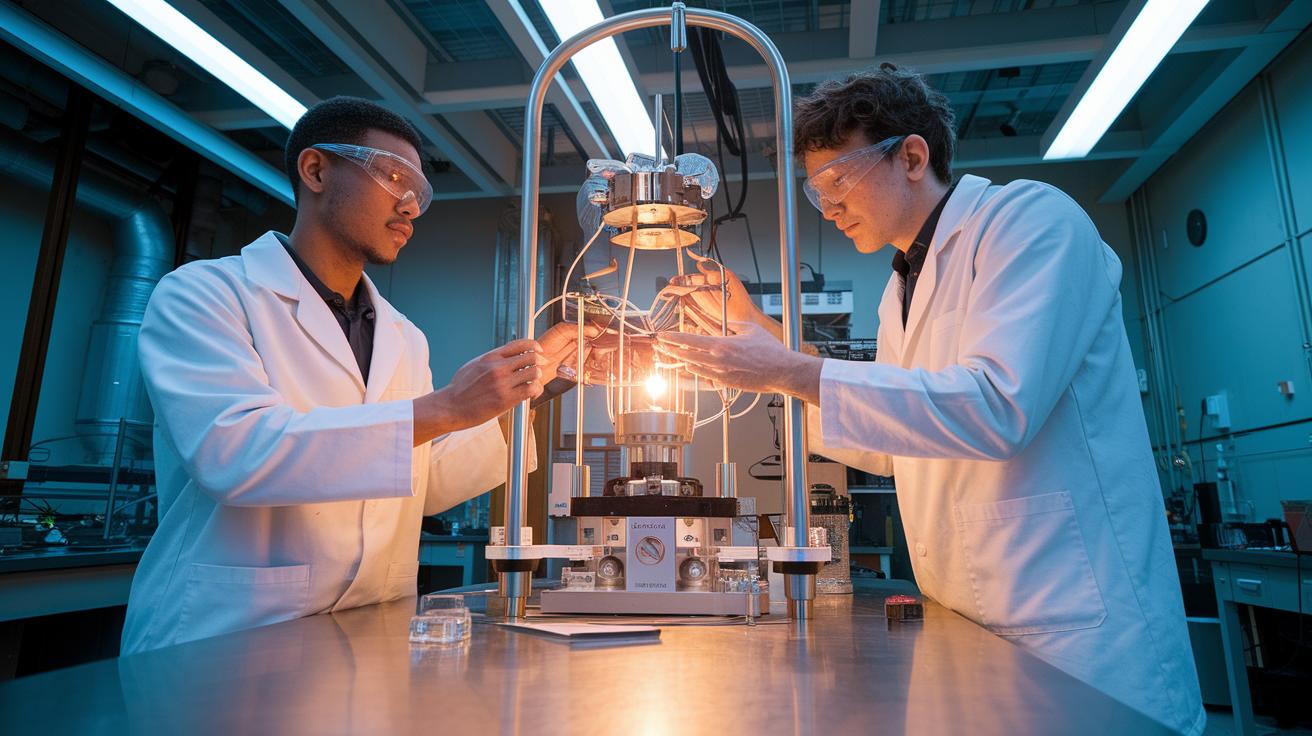
Scientists are working hard to improve detector technology, which is changing how we study tiny particles in physics. By using better tools and calibration (fine-tuning the equipment), they can now pick up even the faintest details of particle interactions. This makes it a lot easier to tell real signals apart from background noise.
What does this mean in practice? When a particle speeds through a detector, the new technology records much more detail than before. For instance, switching from old detectors to new ones, like high-granularity calorimeters (devices that give a detailed energy layout), helps capture each collision event as clearly as a high-resolution image versus a blurry photo.
| Facility | Upgrade | Impact |
|---|---|---|
| LHC | High-granularity calorimeters | +20% energy resolution |
| Xenon nT | Dual-phase TPC | +30% signal-to-noise |
| DUNE (LArTPC) | Real-time 3D imaging | −25% background |
| FRIB RaF Spectroscopy | Ion-trapping & laser cooling | +50% trapping efficiency |
These advances in hardware and techniques are really fueling new breakthroughs in particle physics. It’s exciting to see how tiny improvements can open up a whole new world of discovery.
Energy Smash Analyses and Boson Revelation Studies in Particle Colliders
In these high-energy experiments, scientists crashed protons together at 13 TeV, gathering 150 fb⁻¹ of data (a way to count lots of collisions) to study the Higgs boson. Think of it like a super-powered smash that uncovers tiny secrets of nature. Each collision acts much like starlight seen through a powerful telescope where every tiny flash tells its own part of the story.
They also looked at a special decay where the Higgs turns into a pair of muons. This rare event showed a 3.2σ significance with a branching ratio of about (2.6 ± 0.7)×10⁻⁴ (that tells us how likely the decay is). Similar rare decays, like one where a Z boson becomes four leptons, came in at roughly (4.1 ± 0.1)×10⁻⁶. And on top of that, Fermilab’s muon g-2 experiment spotted an odd twist in a particle's magnetic behavior at a 4.2σ significance, stirring up fresh challenges to old theories.
These clues from rare decays and precise measurements help researchers figure out how bosons behave when things get really extreme. Such experiments bridge the gap between what we predict on paper and what actually happens, nudging our understanding of the universe a little further every day.
Neutrino Oscillation Inquiry and Dark Matter Examination
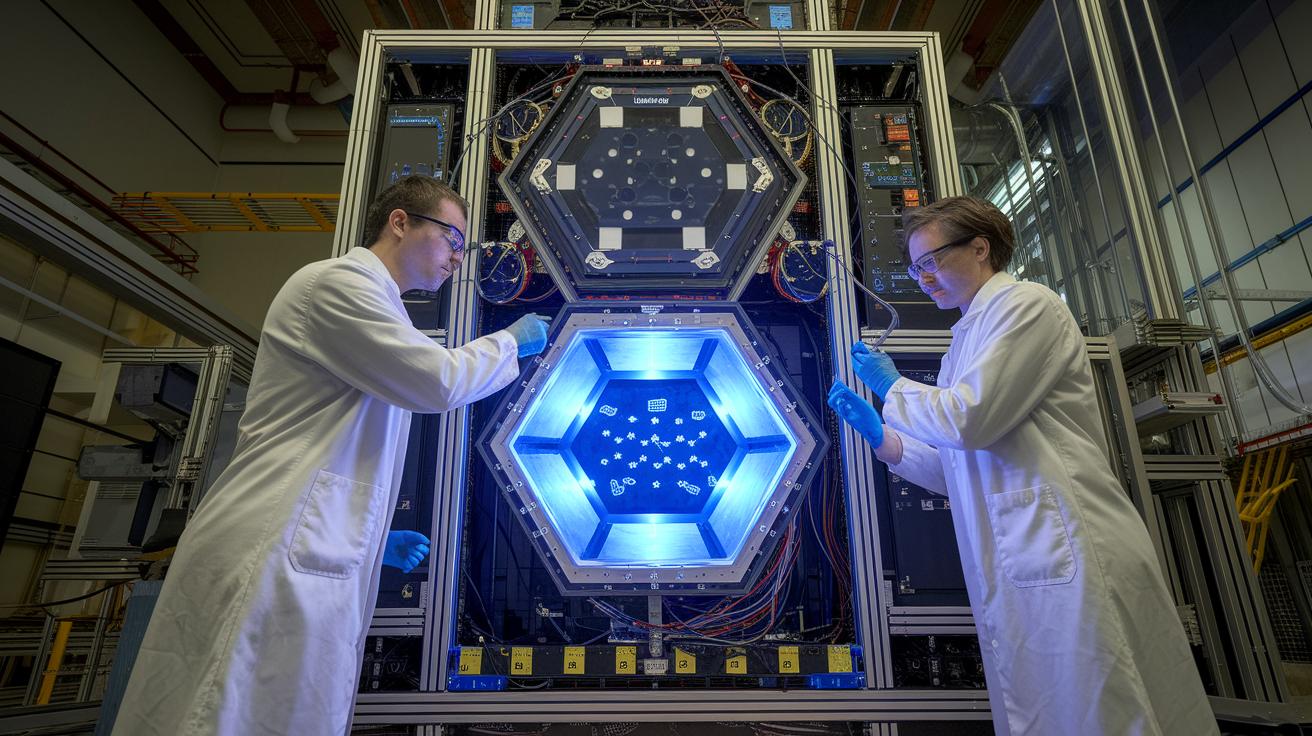
At Super-Kamiokande, researchers measured a neutrino mixing angle (θ₂₃) to be about 45.1° with an uncertainty of ±0.9°. This improvement, 15% better than before, helps us better understand how neutrinos (tiny particles that rarely interact with matter) behave. Meanwhile, DUNE’s first run looked into the δCP phase (a value that hints at differences between matter and antimatter) and reached a sensitivity of about ±45° at a 90% confidence level. These findings are important clues in figuring out why our universe seems to favor matter over antimatter.
At the Xenon nT detector, a new limit was set on the chance of detecting dark matter particles called WIMPs (Weakly Interacting Massive Particles, which are one possible form of dark matter). This limit was measured at 1×10⁻⁴⁸ cm² for particles weighing around 100 GeV/c². Even more exciting is the planned upgrade, which will widen the search range from 1 GeV/c² to 10 TeV/c². This broader range means scientists will have a better chance to uncover the secrets of dark matter.
| Measurement | Value |
|---|---|
| θ₂₃ Mixing Angle at Super-Kamiokande | (45.1 ± 0.9)° |
| δCP Sensitivity at DUNE | ±45° (90% confidence level) |
| Xenon nT WIMP Cross-Section | 1×10⁻⁴⁸ cm² (for 100 GeV/c²) |
| Future Dark Matter Mass Range | 1 GeV/c² to 10 TeV/c² |
Theoretical Apex Discoveries and Model Evolution in Particle Physics
Recent rare-decay measurements have sharpened our estimates for Yukawa couplings (the numbers that decide how strongly particles interact) and given us a fresh look at the Higgs self-interaction (how the Higgs particle interacts with itself). In one study, scientists noticed tiny changes in decay rates, almost like tweaking a recipe to get just the right flavor. This small change has led researchers to reexamine ideas they once thought were set in stone.
New theories are emerging after signals from LHC Run 3. Traditional models based on supersymmetry (a theory pairing every known particle with a partner particle) now include extra elements. For example, scientists are studying additional particles that appear to belong to a hidden dark sector (a group of unseen particles). They’re using ideas inspired by string theory to explore these dark-sector possibilities, bridging the gap between the normal matter we see and mysterious unseen forces.
Another focus has been revising grand-unification schemes, which once predicted all forces meeting at a single energy level. New data suggest that these forces might converge under more complex conditions. Fresh ideas in gauge theory (the framework that explains how particle forces work) are prompting scientists to rethink these proposals. Overall, these advances mark a promising step toward a deeper understanding of the quantum world that makes up our universe.
Accelerative Design Evolution: Next-Gen Collider Projects and Facility Upgrades
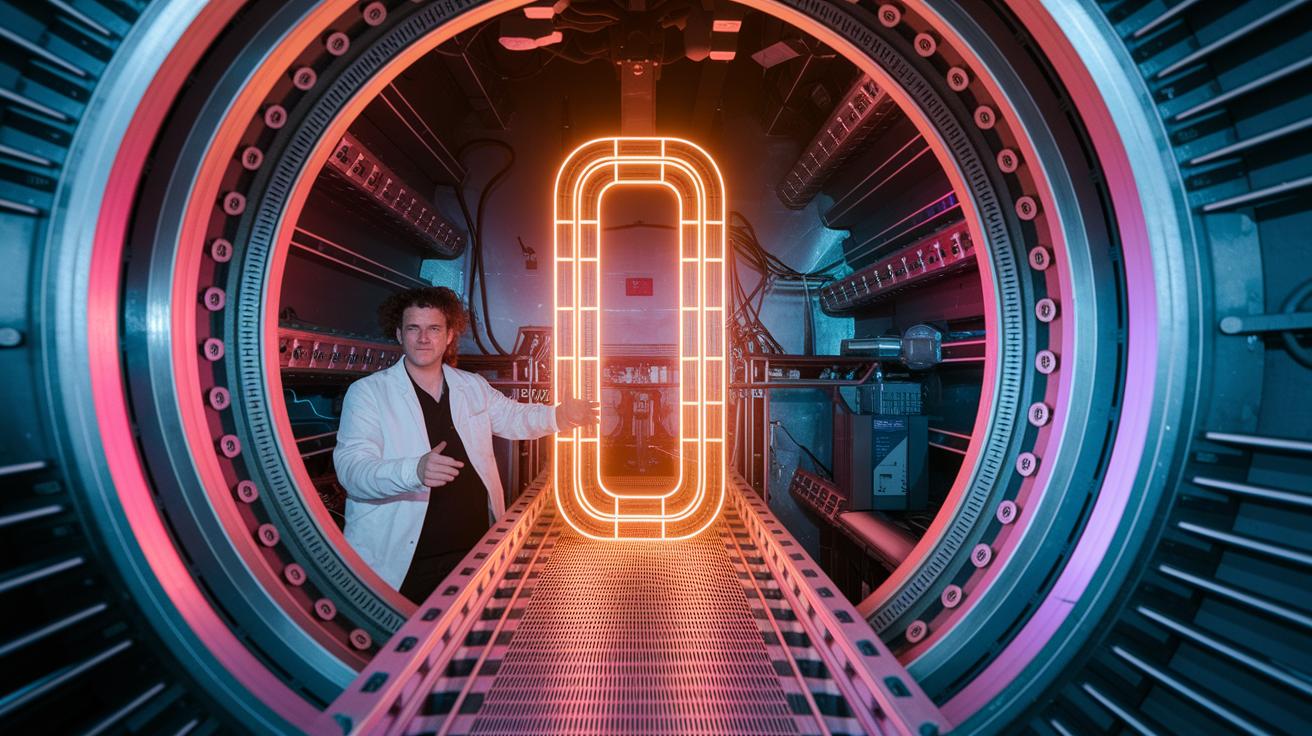
Researchers are redesigning particle colliders with big upgrades that could change how experiments work and improve measurements. The HL-LHC upgrade, set for 2027, will boost the brightness of collisions by ten times using special Nb₃Sn magnets (superconductors that help carry electricity without losing energy). This means that when protons crash, they create much more detailed signals. Imagine it like switching to a super-sharp camera that catches every tiny flash when particles collide.
Another exciting project is the Future Circular Collider, known as the FCC. It aims for collisions with 100 TeV of energy in a giant 100 km ring. The design uses advanced cryogenics (systems that keep things really cold) to ensure its parts work perfectly at very low temperatures. Think of it as an enormous ring cooled down like a high-performance engine during a big test, making sure everything stays stable and precise.
At CERN’s EuroCirCol facility, scientists have recently demonstrated 16 Tesla magnet prototypes, a major step forward in superconductor magnet technology. These prototypes may lead to even stronger magnetic fields in future accelerators, which will help guide particle beams more accurately.
Over at the LBNF/DUNE Far Detector, plans are underway to expand its size from 40 kt to 70 kt by 2030. This significant upgrade will make the detector much more sensitive, allowing scientists to pick up even the faintest signals from rare events. All these advancements show how new technology is giving us ever clearer snapshots of the tiny world inside matter.
Methodological Evolution and Multidisciplinary Collaboration in Particle Physics Research
Researchers are changing the way we study tiny particles by inventing clever new methods and teaming up with experts from all kinds of fields. Have you ever wondered what it’s like to shorten simulation times from hours to just minutes? Thanks to quantum computing algorithms (advanced computer instructions that solve problems super fast), high-energy collision simulations are now 60% quicker. This helps scientists explore complex particle interactions in record time.
At the same time, machine-learning event classifiers in major experiments like CMS and ATLAS are doing a great job of distinguishing the real signals from the background noise. They boost the clarity of experimental results by 25%, making it easier for researchers to see what’s really happening in the data.
Teams made up of nuclear physicists, computer scientists, and materials engineers are also rethinking detector designs. By mixing advanced computer techniques with hands-on engineering, they’re creating fresh ideas that improve the precision and sensitivity of experiments at the smallest scales.
Key collaborative efforts include:
- Quantum algorithms speeding up simulations by 60%.
- Machine-learning tools improving signal clarity by 25%.
- Shared data frameworks used by groups at CERN, FRIB, and J-PARC.
- Multidisciplinary teams developing new detector designs.
These international research partnerships and data-sharing systems work like a catalyst, sparking breakthrough progress in particle physics. When experts from different areas share information quickly, innovative ideas spread fast and push our understanding forward. It’s an exciting time for science as we see these collaborations chart new paths and open up fresh possibilities for exploring the nature of matter.
Final Words
In the action, this article ran through key experiments, upgraded detectors, collider analyses, neutrino studies, theoretical advances, and future facility projects. It offered a clear look at how today's science is reshaping our basic understanding of matter while pushing technology and collaboration to new frontiers. By exploring measurements from radium monofluoride to dark-matter limits and innovative detector designs, the discussion connects scientific detail to daily insights. It all shows the exciting breakthrough progress in particle physics research that sparks curiosity for what lies ahead.
FAQ
Elementary particles and the mysteries of the universe pdf
The question about an elementary particles PDF highlights a resource explaining the basics of subatomic particles and cosmic secrets. It typically outlines current experimental insights and theoretical updates in particle physics research.
Well aimed particles in an accelerator
The inquiry into well aimed particles in an accelerator focuses on how precisely directed beams improve collision accuracy. This precision enhances data quality for advanced studies like those on the Higgs boson.
Elementary particle physics: the Higgs and Beyond
The question on elementary particle physics regarding the Higgs and beyond discusses research into the Higgs boson properties and extensions to established models. This research helps explain both known phenomena and emerging physics puzzles.
What is the breakthrough of particle physics?
The question on the breakthrough in particle physics refers to key achievements such as precise quantum structure measurements and refined collider data, which have reshaped theoretical models and deepened our understanding of fundamental forces.
What is the biggest breakthrough in physics?
The query about the biggest breakthrough in physics spotlights major experimental successes, including high-energy collider studies and precise decay measurements. These achievements have driven significant refinements in scientific theories.
What are the 7 biggest unanswered questions in physics?
The question about the seven biggest unanswered questions in physics points to ongoing puzzles like dark matter properties, neutrino behaviors, and unexplained quantum phenomena. These challenges steer current research and stimulate further inquiry.
Is there anything left to discover in particle physics?
The inquiry into discoveries remaining in particle physics emphasizes that evolving detectors, innovative methodologies, and updated models confirm there are still many untapped areas and potential breakthroughs in the field.